What to Do With Your Sea Eagle in the Winter

Our fearless leader, Cecil, loves going for a morning paddle no matter the time of year.

by Tonya Ferrara

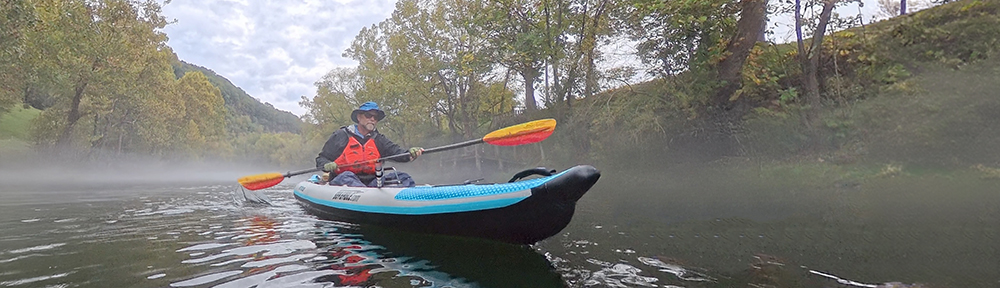
School’s in session, the leaves are turning, cooler weather is coming in, pumpkin spice is everywhere and days are getting shorter.  Though we don’t want to think about it, sadly for many of us, boating season is coming to an end (insert sad face, bring on the tears and get ready to hunker down).  Here at the Sea Eagle headquarters in beautiful, historic Port Jefferson, NY, that means we won’t be going out on the water…as much.  Our fearless leader, Cecil C. Hoge, Jr. does brave the cold for a daily morning paddle in the local bay in his FastTrack or RazorLite or a quick trip around Port Jeff Harbor in his FishSkiff.  And we also must continue to test new boats and products so, on nicer days we’ll man up, bundle up and go down to the water.  And sometimes, the cabin fever just gets to us and we have to head outside.  I mean, we are an inflatable boat company after all and we do live on an island so…

Probably not the nicest of days, but it didn’t keep Hawaiian Dan from doing a quick test of the NeedleNose iSUP.

Though summer’s our busy season, we do sometimes get to have a little fun.

It’s not that our boats can’t take the cold, of course (see PADDLING WITH SEALSOn the FastTrack™ to Copenhagen and SAILING AMONG THE ICEBERGS).  It’s just that it can get a bit too nippy for us mere mortals. I mean, standing on a dock or beach or in a boat taking photos all bundled up in a heavy winter coat, hat, and gloves may seem glamorous but trust me, as near & dear to my heart as they are, it’s not always fun standing in bitter breezes taking photos and videos of our boats. But one must do what one must do for the sake of ingenuity, quality, and fun.

T-shirts & shorts to winter coats and gloves, as long as it’s not raining or snowing, we’ll take to the water.

Now, just to be clear, the cooler months are a fabulous time to go out for a paddle or to motor around.  Our bays are far less crowded – that means very few boats and no swimmers to navigate around. Also, the water is cleaner and clearer since motorboats are not churning up the bottom. Plus, the weather is brisk, so no danger of mosquito bites (fist pump!). And on sunny days the air is clear and refreshing.  So, as long as the water and weather conditions are favorable and it’s not snowing (except for crazy Hawaiian Dan that one time) or raining hard we can head down to the water for some photos or testing. And because developing new models seems to often take far longer than anticipated, we often find ourselves testing final prototypes in November, December and even January.

A warm autumn day is a perfect time to hit the water in the FishSkiff.

Safety and Comfort First

If you do go paddling in the colder months, remember to dress properly.  Wear layers, you’ll warm up especially if you paddle hard, but its chilly out this time of year so it is better to overdo it.  Waterproof gear is a great way to go – gloves, jacket, pants, shoes.  You may even want to keep an extra set of clothing in a dry bag just in case. Also, be sure to know the weather and water conditions and to let someone know of your float plan – where you’re going, when you’re leaving and when you plan to be back.  You can even fill out a U.S. Coast Guard Float Plan form with all your information.  Basically, use common sense when going out on the water no matter what time of year it is.

Most important of all, do NOT forget to wear a life jacket. It is always a good idea in spring and summer to wear a life jacket, but in fall and winter this is even more important. In our parts it is the law to wear a life jacket when paddling November through March. This is because the water temperature can be close to freezing and any exposure to cold water for more than ten minutes can put you in serious jeopardy of hypothermia or even death. So please always wear a life jacket when going out in the colder weather. This is particularly important because in the Fall and Winter there may be no boats to come to your rescue.

Don’t be a “NO.” Wear your life jacket the correct way all the time! Especially in fall & winter when hypothermia sets in quickly .

We also especially recommend the Sea Eagle Waterproof Kayak Blanket to keep you warm and dry.  This polartec lined waterproof blanket protects against wind, cold and the dreaded paddledrip that somehow works its way from your paddle to your clothes. Yes, even if we are pretty hardy people, it is nice to be toasty and dry while out paddling or boating.

I used the Sea Eagle waterproof blanket while riding in one of our Sport Runabouts one chilly winter’s day and let me tell you, this puppy works like a charm!  Obviously, I wasn’t paddling in a kayak, but it was a pretty brisk day when we headed out of Port Jeff Harbor into the Long Island Sound to get some photos of the FishSUP, I believe.  As we were heading through the channel another boat passed us going way too fast for the area and SPLASH! I got soaked!  Well, I should say I would have gotten soaked, but thankfully, I had the blanket covering my feet, legs and arms (yes, the blanket’s 53″ long, but I’m only 60″ tall so most of me was covered).

Staying warm & dry with our Waterproof Kayak Blanket – it’s not just for kayaks!

Safe Storage for the Winter

When we’re not out on the water, we keep our boats folded and in their storage bags, when possible.  The best place for them is in a temperature controlled room, but like you, we don’t always have that option.  So, we’ll stack the folded boats in our annex in a spot where they cannot fall or something cannot fall on them.  In frigid temps, our unsupported PVC boats (SE 330s, 370s & 9s) can become rigid and sometimes brittle, so it’s always best to store them where a sudden impact is not possible and where unfolding them is not necessary.

Piled up for the winter.

Storing an inflatable boat in a closet, garage or basement in a high place is best. But if that’s not feasible and you need to keep your boat in a shed, find a clean garbage can or plastic storage box with a tight lid – one that is big enough for your boat and inflatable seats to fit in completely with the lid firmly closed.  This will help prevent mice and other critters from chewing a big hole in your boat.  They might be little, but they can do some major damage, even rendering the boat useless.  At the very least, it could ruin a planned trip and cost you time and money to patch the holes.

A little rodent can do MAJOR damage to inflatable boats. Store your inflatable properly to keep it safe!

At Sea Eagle, we love…I mean LOVE being out on the water. We’re totally in the wrong business if we didn’t.  Sometimes, though, the weather just doesn’t cooperate here in the Northeast and we have to pack up our beloved inflatable boats, kayaks and SUPs and begin the countdown to spring or hope for the odd warm winter day. If you live in an area where the weather is warm and the conditions are perfect all year, you’re very lucky, take advantage of it.  If not, be sure to pack up your boat and store it properly, so when warmer days do come, you can just unpack, unfold, inflate and go!

EARTH, WIND AND FIRE – the week it only got worse, but all was good in the end

Catching a beauty like this makes any day better!

by Bill Marts

I had just received my new Sea Eagle FishSUP12.6 inflatable SUP and wanted more than ever to get to fly fishing for carp. I am new to fishing from a SUP. But I have day-dreamed, thought about, imagined, planned for and was making it happen on this trip. I KNEW it would be a perfect platform from which to hunt for carp. I, 99% of the time, sight fish for carp and shallow-water fishes (bass, bluegill, crappie etc.) and fishing from a SUP had to be the answer. It is all about stealth with shallow-water-flyfishing and sighting the fish. I also wanted to fish the SUP during a Carp Tourney I organized for Emerald Water Anglers, a fly shop in Seattle, WA. It was being held in Eastern Washington at Banks Lake about a month later. I wanted to know what I was doing at the tourney so I finally traveled to Eastern Wash (over by Vantage), the temps were near and at 100 the whole week. But, have to tell ya, I loved fishing in it. This was in preparation for the tourney. I had fished with the FishSUP the week before and got towed around (fun ride) by a few BIG carp before the hook straightened out on both fish and I was looking forward to trying again with stronger hooks. The FishSUP is designed for an electric motor, so I put one on. I was at the downwind leg, of my first drift of the week, fishing on my new SUP and, so far, it was great, casting to a carp here and there.

Heading out to find some carp.

Got to camp a little late and set up after sundown and looking forward to dinner. Then, I couldn’t use my stove because the wind was blowing soooooo hard. It got up to 60 mph (official) during night and morning. That was OK, my tent held up with no problems, except at 4:30 am, the fire trucks set off their sirens and flashing white and red lights in the campground with the announcement of a level 3 evacuation. GET OUT NOW!!! I could see the wildfire’s glow barely a couple hundred yards away. I got everything thrown, including my SUP, in my truck except my tent when they came by again and said, “leave the tent”. At least I got out OK. Everything was all good then until I rear-ended the guy’s trailer in front of me. Just little dents. Idling in my truck while looking in the rear-view mirror at the fire closing in on the campground. The guy in front of me was good about it.

I calmed down some and went to a nice place at Burkett Lake; made some phone calls to let everyone know I was OK; took a nap and decided to go fishing at another place. Good plan EXCEPT the truck battery was dead. OK…… I just joined AAA this year and they would come to where I was and give me a jump. Great! Three hours later he showed up and jumped the truck and the world was good again. Backing up, I didn’t realize how close the tow truck was to the rear end of my truck. UNTIL I hear this crunch and I look back in the side mirror to see my passenger-side tail light (the whole unit) hanging from its wires (good thing for wires). This kind of got to me and I yelled F*%$ so loud it was still echoing off the canyon walls two days later. All is well —— Just like Red Green, I go nowhere without Duct Tape. The tail light still worked. So, I taped it back on. Too late for fishing so I stopped into a small cafe in Mattawa. I was looking forward to a quesadilla and a cold beer. Slept out under the stars (my tent back at the campground) and it was great. Had my cot and pad. Had some tunes (Allman Bros Eat a Peach album). Had a cold beer. Watched the clear, star-speckled skyway late into the night. Had a great day of fishing the next day with a friend. Went back to the camp and they had taken my tent down and stored it at the ranger station. What a kind thing to do. Went to another lake campground where I was to meet another friend; set up camp again, settled in to have a hot dinner of brats and chili. BUT, I couldn’t get the stove to work. Cold dinner, but I had cold beer. So, it wasn’t a total loss. Beautiful night with calm winds.

Busted tail light won’t keep me down!

The stars are aligned again. My friend arrived at 9 am and we went out on the lake fly fishing for carp. Great fishing. Except for my broken rod on a huge carp. Not to worry, tho. I had a spare back in the boat. Got it rigged up and got back to fish. We both hooked more, that is- UNTIL I slipped in the mud in the lake in a hole and then pulled a muscle in my neck as I was looking UP at the water surface. My feet were doing that forward shuffle (like when snow skiing) and your upper body is leaning back and your feet are up in front of you like trying to walk up a wall. I was still straining, looking up, trying to get to the surface to gulp in some much-needed air. The oddest thought went through my mind while under water, I was thinkin’ “it would be so embarrassing if I were to drown while wading a lake in 3 feet of water. I finally came to the surface. YEAH!!! Another great day as hot as it was there, I am super cooled off.

Well, now it is lunch time, Thursday. Good lunch with a couple of cold pops. Went to one more place. Fish everywhere. Hungry fish. BUT, the mud was up to ankle-deep and was like walking in glue. Every step required rocking your foot back and forth to release the suction, I wished I had the FishSUP at that time but we were fishing out of my friend’s boat. The fishing was better every step forward. There were so many feeding fish that I finally figured it was better to stop and stand still and cast to passing fish. It worked! EXCEPT….. the longer one stands in one place, the more the mud sucks in/down one’s feet. I had been there quite a while and saw a particularly large carp just out of casting range. I took a step toward it, but only in my mind. My feet were Stuuuuuuck. I took another dip in the lake. Since I had some experience in this type of event, I only went in up to my chest. I got up quickly and tried to rock my way out of this predicament. My feet stayed put but my body went forward again. By now, I am very skilled at this game. I started to move but no fish around. All is good again. It is still hot and I am very cool. All in all a great day!

Packed up the next day to head home and it went smoothly. Got home in good shape. I THOUGHT….Later that night I discovered that I had been chewed on around both knees. Little round red marks. No big deal. UNTIL the next day when they appeared much redder and blistered. They broke later in the day. So, life is great again. But, I still have marks some 6 weeks later. Wonder what it was??

I am heading back in 6 days for 4 more nights of camping and carp fly fishing at the 2nd Annual Carp Jamboree. If only it can be as good as last week!


The 2
nd Annual Carp Jamboree, 2018.

Well, I went to Banks Lake at Coulee City Community campground (our headquarters) the next week three days ahead of tournament day of the Carp Jamboree with my brother (Boyd). We got camp set up by mid-day and some friends showed up early, too. Water was calm and perfect so we went fishing. The fishing was awesome. Next day was the same. Great water, skies (need clear skies for good sight fishing) and fish were on the feed. I was getting excited for the tourney. Friday was also good, but Boyd and I stayed in to prepare for other participants arriving and getting ready for a Carp Fly Fishing Clinic I was to give that late afternoon. It went well. The forecasts were for some winds in the AM, getting calm by afternoon. That is good enough!

BUT…..the forecaster forgot to tell Boreas (Greek god of north wind). The North and West winds blew hard bringing the air and water temps about 10 degrees lower than the last three days. No using the FishSUP this day. I just don’t know how to paddle against heavy winds. Where fishing had been excellent the last three days, now there were no to hardly any fish, unless you could go miles up-lake where the wind was not as much of a problem. I was not going to fish for any of the prizes, but I wanted to fish on the FishSUP. No luck this trip.

The winner, Matt Paluch, landed 7 carp this day. He took home the FishSUP 12.6 as his choice first prize. Other participants won rod, reels, fly lines, chest packs, hats and stainless-steel water bottles. Everybody got something whether they caught a fish or not. I had delivered to our camp, pizzas, chicken wings and salads and, of course, the keg was tapped and everyone enjoyed the party into the evening. Can’t wait for next year’s jamboree.

I am now waiting for the arrival for my next craft from Sea Eagle; the FishSkiff16. I will use it for guiding shallow waters in a silent, stealthy manner, next year. We’ll “Fish like a Heron”.

True story, Bill Marts.


It was a crazy week – wild fires, busted tail light, broken stove, broken fishing rod, bug bites…but at least the carp were still biting.


FOR J.P. GARZA, SEA EAGLE’S RAZORLITE® 473rl LEADS TO ADVENTURE

J.P. shared an expedition with friends on the Papaloapan River in Veracruz, Mexico.

By Tom Schlichter

“I’m all about adventure,” says J. P. Garza, 51, of Villahermosa, Tabasco, Mexico. “I love to explore and discover natural new places, especially by water in the southeast of my country and in Central America.”

Garza has traveled most of these regions by roads, terraces and trails, not only by car but by mountain bike as well. In fact, until recently, he considered himself a serious cyclotourist. These days, however, he prefers touring with his Sea Eagle RazorLite® 473rl inflatable kayak (IK). He has paddled over 3,000 kms (1,900 miles,) he says, never repeating the same river, lagoon or sea shore.

“Water is a resource that abounds in this area,” explains Garza, “and it offers a different perspective when exploring and enjoying the natural world. Rivers are the oldest paths of my country and while many have forgotten their importance these days, they have served as the main means of communication in the jungle since the pre-Columbian era. That’s why their shores host old churches and abandoned ancient cities – and it’s why I think waterways are the best and most interesting means to discover and learn about the natural beauties and historical places that we have.”

Garza stresses such adventure and contact with nature must be accomplished with respect for the environment and an ecologically healthy approach. If it can also be inexpensive, so much the better. Inflatable kayaks, he says, are the perfect fit as they allow him to achieve all of the above. Being able to maintain a decent speed without the noise of an added motor lets him quietly cover plenty of water and leads to more wildlife encounters.

The Champoton River in Campeche, Mexico, says Garza, is a beautiful stretch you can really only see and enjoy fully by way of an inflatable kayak.

“Using my IK, I come across a lot of wild animals on these trips,” reveals Garza. “Some, like a jaguar I spotted in the Belize River, few people ever get to see in a natural setting.”

Another important reason for kayaking on these expeditions, states Garza, is that it allows access to places larger vessels can’t navigate due to rapids, shallow waters or other obstacles. What you can’t push through on the water, you can sometimes bypass by carrying your IK, he explains.

In his expedition search for the beginning of the Champoton River in Campeche, Mexico, Garza had to back-pack in his Sea Eagle RazorLite® 473rl inflatable kayak.

“Many of the places I explore have never been navigated,” continues Garza. “I do serious expedition tours, so I need a kayak that’s inflatable to have the freedom to transport it in any way: taxi, bus, Uber, car or even carrying it on my shoulder. Using my Sea Eagle RazorLite® I have navigated rapids, flat waters and the open sea. It’s extremely versatile, easily portable and – inflated at 10 psi -incredibly hard. Its overall performance is as good as a hard shell kayak yet it remains as portable as a regular IK. Sleek and narrow, it goes real fast but remains tough enough to take far from the nearest road with no concerns about getting back. Stability is another issue that kayakers are always worried about, but not me. My RazorLite® handles anything Mother Nature dishes out.”

Given his need to travel long distances – not always an easy task in the areas he explores -Garza especially appreciates that he can simply pack up his RazorLite® and bring it anywhere. He also loves that it folds into a small square that can be easily stored. Storage room is at a premium in many Mexican homes, he notes, so being able to put it away neatly is a real plus.

“My Sea Eagle RazorLite® weighs only 35 pounds,” says Garza, “and it packs-up nice and tight. It can also take a beating and keep on going. My girlfriend Xiomi and I took it close to the Guatemalan border recently and paddled over 400 kms (250 miles) down the Usumacinta River to the Gulf of Mexico. We needed the fastest two-person inflatable kayak in the world to travel such a distance in only five days and the RazorLite® was it. On the last day of the expedition, Xiomi and I had to paddle over 100 kms (70 miles) from Jonuta to Frontera City as there were no places to stay the night. I’m convinced the Sea Eagle 473rl is the only two-person IK in the world that can cover so long a distance in a single day.”

The Usumacinta River, which flows though southeastern Mexico and northwestern Guatemala, provided Garza and Xiomi with a more than 400 kms (250-mile) IK adventure.

It would be almost impossible to do the expeditions he and his girlfriend undertake twice a month using a hard shell kayak, believes Garza. “The logistics would be too complicated, especially when you have to cross international borders. For us, it doesn’t make sense to waste the extra time, money and effort to travel with a hard shell. Many traditional kayakers don’t know about the latest IK technology. They don’t know how fast and how tough these kayaks can be, especially with drop-stitch design like Sea Eagle uses in its RazorLite®. Hopefully, my fellow kayakers are starting to see this when they view my adventures on social media or read the articles I write in magazines and Mexican newspapers.”

As for the RazorLite’s speed, Garza finds it exceptionally fast. “My girlfriend and I entered a 37 kms (23-mile) hard shell kayak race with it and finished third overall. We were the only IK in the race. The RazorLite’s sleekness is one reason for its great speed; another is that it is so steady and solid it feels like a hard-shell kayak. It’s as tough as they come, and very responsive. It lets you get in a lot of exercise without feeling like you are doing that much work.”

J.P. and his girlfriend, Xiomi, recently took third place in a 37 kms (23-mile) kayak race. Their Razorlite was the only inflatable in the field.

Garza says there are places in Mexico and Central America that can be reached only by kayak such as the lost archeological site Arrecife, which is hidden in a small islet in the north of Cozumel. The entire Champoton River, from its remote beginning to its terminus at the Gulf of Mexico, is another example. Here Garza had to backpack in to find the narrow creek which served as the river’s origin. (You can see a clip of this trip on JP’s Facebook page, here.)

“I push into places other people rarely see and I find that tremendously rewarding,” surmises Garza. “When you get into these places, you never know what you might see. Last winter Xiomi and I navigated in Expedition Gran Arrecife Maya, paddling more than 500 kms (310 miles) from Majahual, Mexico to Rio Dulce, Guatemala. Over 17 days we used our inflatable kayak to explore the second largest coral reef in the world. We saw amazing islets and breath-taking scenery. There were many kinds of wild animals here including sea turtles, dolphins, alligators, monkeys and a great diversity of fish.

“I think if more people kayaked, they might have a better appreciation for the environment and all things beautiful, peaceful and wild. That might help them to be more conservation-minded – and that’s something we really need in today’s world.”

At Sea Eagle, we couldn’t agree more.

Ingenuity Opens New Doors for Disabled Paddlers

At the SportsAbility event held in Tallahassee in April 2018 by the Florida Disabled Outdoors Association, attendees were able to experience the joy of getting out on the water on an iSUP thanks to Tom Weldon who designed an amazing device to allow those with disabilities to paddle safely. Tom is pictured here with Maxim Davis. Photo courtesy of FDOA.org

By Tom Schlichter

“I can’t tell you how good it feels to get back on the water and paddle,” says David Jones. “It’s taken a lot of experimenting over the years, but we finally have something that works really well.”

Jones, president of the Florida Disabled Outdoors Association (FDOA; www.fdoa.org), is a 63-year old hemiplegic who cannot use his left arm. He loves to be on the water and, up until this summer, had greatly missed being able to fully participate in paddling situations. With the help of fellow FDOA member and friend, Thomas Weldon, however, Jones is thrilled to be back in the game.

“I’d made several unsuccessful attempts to kayak using different types of paddles and adaptive strap-on devices,” explains Jones. “None of them worked out very well so I basically gave up on paddle sports. With help from Thomas, however, we finally figured out something that works – and it’s opened a whole new world of things I can do, places I can go and groups I can join to have fun on the water. Just recently, for example, I took a trip with Thomas on the Withlacoochee River in northern Florida. It’s such a beautiful place – one I couldn’t have fully enjoyed until now.”

With the help of Tom’s invention and SportsAbility, this young man is able to feel comfortable and stable enough to paddle the Sea Eagle NeedleNose solo. Photo courtesy of FDOA.org

In addition to the awkwardness of most adaptive paddle devices Jones tried out, he found that simply getting in and out of a sit-in style kayak presented plenty of problems, especially during the course of activities. Still, after outfitting yet another sit-in kayak with new adaptive gear, Weldon convinced his buddy to try again. That’s when he came up with a radical idea. While following Jones on a Sea Eagle NeedleNose™ 14 (NN14) inflatable stand-up paddleboard (SUP), Weldon thought of switching the setups to put the adaptive gear on the inflatable SUP. That, he suspected, would be easier for Jones to maneuver, balance, and mount or dismount.

“Worked like a charm,” said Jones. “Thomas went home and built an adaptive apparatus to mount onto the Sea Eagle SUP and it turned out to be great as a sit-down device. He started by securing a sit-down kayak-type seat on the board that enabled me to sit and brace myself so I could paddle with one hand. For the paddle, we used an Angle Oar (www.angleoar.com). It’s an adjustable, double-bladed oar attached to a pedestal that sits between your knees and rises about 18 inches from the floor. The oar pivots on the center of the pedestal. As you lift it with one hand it puts the paddle in the water on the opposite side. So, you actually use a rowing motion to dip the blades with a kayak paddling rhythm.”

Getting ready to hit the water! Tom’s making sure everything is set for Sunil Patel. Photo courtesy of FDOA.org

To make the SUP extra-stable, Weldon added small outriggers which also responded to foot pressure for improved steering. Attaching everything to the paddle board proved easy since the NN14 had plenty of D-Rings conveniently positioned around its perimeter for securing accessories.

“The seat configuration, along with the Angle Oar, proved a perfect matchup for the Sea Eagle SUP,” continued Jones. “We used it very successively on a river run and plan to use it now on a regular basis with a paddling program we are about to start. Because the NN14 is an inflatable that weighs just 27 pounds we can load several in a truck at once. That makes the logistics of getting them all to the launch site relatively easy. Once there, each SUP takes less than 10 minutes to inflate.”

Tom and Sunil loving the great outdoors! Photo courtesy of FDOA.org

Of course, helping the physically challenged enjoy the great outdoors is what the Florida Disabled Outdoors Association is all about. According to Jones, the program has a mailing database of roughly 16,000 members and offers a series of outdoor adventure trips throughout the year. The program includes paddling sports, water sports and a variety of other outdoor activities. Twice a year the group hosts a major SportsAbility event, drawing between 1,000 and 1,500 participants to each gathering. Their year-round Miracle Sports Program has about 200 active participants, an ALLOUT adventure series offers a variety of outdoors opportunities including hunting, and a program designed to provide resource information for those with brain and spinal cord injuries serves several thousand more.

In addition to paddling, Jones loves to fish. That has led him and Weldon to consider exploring the possibilities of building an adaptive paddle device for Sea Eagle’s inflatable FishSUP™ 126. That paddleboard is wider and even more stable than the NN14, and it is easily tricked-out to be an angling machine.

“We definitely have to look into that one,” says Jones. “Who knows, being wider and super-stable, it might even eliminate the need for outriggers. Wouldn’t that be great?”

GOING MOBILE WITH THE SEA EAGLE 385ft FASTTRACK™

Colt Creek State Park, FL, happy and calm to start the day.

by Tom Schlichter

Suzanne Daigle had wanted an inflatable kayak for a long time. She wasn’t quite sure where to start looking, but she did have a pretty good idea of what she needed.

“Fortunately,” she said, “a friend steered me over to Sea Eagle and it turned to be a perfect match. What great advice!”

Daigle, you see, was planning to sell her house, buy an RV, and drive around the country checking out places she had always wanted to visit while finding new spots to investigate along the way. It didn’t take long for her to do some research and narrow her potential kayak choices down to a few Sea Eagle models. As soon as she sold her house, she was on the phone to place an order.

Suzanne’s Fast Track conveniently fits under her RV, so if she decides to stay near the water for a few days she just tucks in and adds a lock and chain to keep it safe and conveniently in reach. Keeping it under the RV also shades it from the sun which, in the long run is good for the kayak shell and color retention.

“For me, that was a symbolic moment – I had the proceeds check from my house sale in my hand, ready to deposit and was already making the call to Sea Eagle from my car. I was heading out on the road with no turning back. It felt exciting, refreshing. It would be the adventure of a lifetime. Having that new inflatable kayak and RV was just the starting point.”

Initially, Daigle, who works full-time as a business consultant, both nationally and internationally, was thinking about a different kayak model but the Sea Eagle customer representative who answered the phone helped her find an even better match for her new lifestyle.

“He took the time to ask me about the kind of things I wanted to do on the water and what I thought was important in a kayak,” revealed Daigle. “After a bit of conversation, he suggested the 385ft FastTrack™ Pro Carbon Package. It turned out to be a sweet fit for my new lifestyle. I’m an organizational transformation consultant. I work hard to help businesses give their employees a greater say in important decisions. I wanted to live my personal life the way I invite organizations to step out and take more risks.”

Two things Daigle knew she wanted in a kayak right from the start was the flexibility to handle both small and large bodies of water, and the feel of a “good kayak” ride. She had previously owned a hard-shell sea kayak that she took on New York’s Long Island Sound and even used to paddle across the Hudson River. These days, based in Florida, she hopes to paddle on the Gulf Coast, tuck in and out of inlets and bays, plus poke around on rivers, lakes and ponds.

One thing Suzanne Daigle really loves about her Sea Eagle inflatable kayak is that she can pull it out of her RV and be on the water in ten minutes. It’s perfect for big water or small – anywhere, any time.

“I’m not planning on whitewater rafting,” Daigle explains, “but I still want the flexibility of a smooth ride in gentle waters as well as the stability and ruggedness necessary for wide open spaces. A little extra room to carry stuff along is necessary, too. I like to bring my breakfast on the water, a towel and enough gear that if I happen to find a little deserted island to relax on I’ll be able to just hang out for a while. The 385ft FastTrack™ has plenty of room, a pair of clip-on dry storage bags, and a great set of paddles that are both exceptionally strong and lightweight.”

Daigle says she is still just getting to know her inflatable, but she’s real happy with it so far. She said she was “blown away by the quality” of the kayak and its accessories. She loves the comfort of the pro high back seats and how easy it is to inflate and deflate. On a recent trip to Lake Placid, FL she paddled on expansive Lake-June-In-Winter before transitioning to a smaller lake and found her FastTrack™ easy to transport, paddle and maneuver in both situations. She’s had it out in strong winds, on quiet mornings, and even on a Florida pond that held a few alligators.

“My brother, an ER doctor, was very concerned that I launched on that one,” she chuckles, “but I felt quite safe since the Sea Eagle is so tough. The company has a video where someone drives a Jeep over one of their inflatable kayaks and there’s no visible damage at all. In that same video, they repeatedly put the claw of a hammer to the hull and it just bounces off. That’s one rugged inflatable, so I haven’t felt worried at all.”

On her most recent trip, Daigle found herself all alone on a beautiful lake, which she instantly realized was exactly why she wanted a Sea Eagle in the first place.

“Sometimes, I just want to get away from it all, to explore, to relax – whether I’m going around the corner or across the country. With my new kayak, I just pull it out of the RV, take ten minutes to inflate it, and go. It’s so easy – no renting, trailering or dealing with anyone else. I’m fully self-sufficient when it comes to kayaking now. That gives me a tremendous feeling of independence.”

As for setting up, transporting and storing the 385ft FastTrack™, Daigle reports it’s been a breeze. She viewed videos on the Sea Eagle website that explained how to easily assemble, inflate and fold-up the kayak for storage, which got her up and paddling in no time.

“Really,” she says,” “it’s nothing you can’t handle. I decided on the Carbon Pro Package because it had everything I needed. It has two tall-back clip-in seats with good back support, two double-end paddles with carbon shafts and asymmetrical blades, two stow bags, a foot pump that works just fine, a slide-in swept-back skeg, plus a repair kit and carry bag. Buying everything together as a package deal saved me about $500 over buying each piece as an accessory.”

One accessory Daigle did add recently is the EZ Cart, which can make transporting a little easier if you have to cover some distance between the car, RV or truck and the launch site. This innovative thinker, however, took the wheels to another level.

“One day my brother-in-law said he saw someone towing a kayak behind their bike,” she reveals. “The first chance I got, I was doing the same. A few straps lashed to the rack on the back of my bike and I was on my way towing my kayak like a pro. So, here I am in my early 60’s, riding my bike, hauling my Sea Eagle inflatable kayak and ready to hit the waters wherever it takes me.. I’m thinking to myself: ‘Wow! I can kayak anytime, anywhere.’ That is so cool. Just pull my Sea Eagle out from the RV and go.”

Where is Daigle headed next? She claims to have no specific destination in mind yet but travel she will.

“For now,” she says, “it’s mostly where my business leads me – maybe out west. I’ll just take things day by day – but wherever I go you can bet my Sea Eagle FastTrack™ is coming along for the ride.”

50 Years of Selling Inflatable Boats – Part 1 – The Early Years

This old, somewhat wrinkled picture shows me about to be crushed on a 10 foot wave. To get some perspective of this shot, the kayak I am on is one of our original 10′ 8″ Pyrawa kayaks. Seconds later the Pyrawa was upside down and I was headed for the beach feet first, pronto.

By Cecil Hoge

It is remarkable for any business to survive for any extended period in this age of endless changes and endless challenges. To survive 10 or 20 years is an accomplishment. To survive longer is more remarkable and to have survived 50 years borders on the mystical.

No matter. It is with great pride that I can say that I am, and our business is, in its 50th year of continuously selling inflatable boats. Given that fact, I would like to provide a kind of personal history of our company.

The Early Years

When I started in my father’s business I had no intention of working in the business. In fact, one of my conditions, in the beginning, was to work only on the night shift so I could keep the day free to seek my dream profession. The profession that I hoped to be successful in was writing. And while I have managed from time to time to get some things printed, I cannot say that I ever succeeded in my dream profession.

What happened instead was somewhat more strange and perhaps, more predictable. I began in 1968 when our business was mostly a fishing lure business. I first worked on our fishing rod production line, managing a bunch of hippies from 4pm to 10pm, Monday through Friday. Since I was a kind of a hippie at the time that was not very hard. Rod production was not our main business in those days, but it constituted a reasonable amount of sales.

This is a not very terrific picture of the product we produced – The AutoCast Rod – a fishing reel gets attached just above the black handle and a fishing line goes from the reel through a couple of eyelets into the cup, where, theoretically, it is tied to a fishing lure.

The product I was helping produce was called the AutoCast Rod – see the picture above. It was a specialty fishing rod that could cast a lure 30 to 40 feet automatically. It was not push button automatic, nor was it digitally automatic. On this product, you attached a spin cast spinning reel and a fishing line with a lure at the end of the line. Then you had to pull back a lever about 18 inches, snap into a notch and then when you were sure your lure was in the little cup at the end of the rod, you would release the lever from the notch and the cup would spring forward and cast the lure and the line about 30 or 40 feet.

This product was just one of a long list of strange mail order products that my father had chosen to sell. As such, it was pretty successful. Sold primarily to mail order catalogs that mostly do not exist today, this product was a good seller. At the time I came into the business, this product enjoyed an increase in sales from 20,000 units per year to 40,000 units per year. It turned out that although most people did not want to use it, there was a select group of people who really did like it. Those people who did like it were mostly paraplegic or physically handicapped so they could not cast or fish otherwise.

What compelled my father to get the right to sell this product I will never know, but for about 10 years it was a good seller. I remember we sold it to Madison House, a mail order company selling a vast number of quirky mail order products, Lillian Vernon, another mail order house that also sold quirky mail order products mostly for women or for the home and to several other mail order companies.

So, it fell upon me to manage a group of about 10 misguided hippies in an effort to boost our fishing rod production and meet the mail order demand from the catalogs we were selling to. During the day, my step-mother ran a production line for the same product and they were producing 300 to 400 rods a day. That was not enough to meet the demand this product suddenly enjoyed. That was because several new catalog companies had recently put the product in their catalogs.

The fishing rod production line consisted of about 15 drill presses and assorted sawing and drilling and riveted instruments, all of which had been jerry-rigged by the original inventor of this product. I have to say that the guy had been pretty smart in what he did. Basically, a rod started out as some metal and plastic parts that had to be cut and drilled and inserted or riveted and then passed further down the line. As it went down the line other parts had to be added or inserted, such as screws or springs or fiberglass rods or plastic cups. Eventually, at the end of the whole line an odd-looking fishing rod was produced.

In this production process, I quickly learned that the amount of production possible could vary incredibly. When we started out my intrepid team produced a whopping 7 rods the first night. It seemed that everything went wrong that evening. Being a competitive kind of guy and hating the fact that the day shift was producing over 300 rods while we had turned out a measly 7 rods, I quickly reviewed my production team and the process we were using. Something was wrong for sure, but at first, I could not figure it out. The next night, I was able to get the production up to 26 rods, so, something was still wrong.

Now, at first I worked on the very first drill press, but then I noticed that things quickly bogged down at the second drill press. Then I worked at the second drill press and found out that things bogged down at the third production station.

To make a long story short, I moved to the end of the line and just started to go faster than the 10 hippies in front of me. Now, my 10 hippies were actually pretty good guys and in their own way, somewhat competitive, so pretty soon the whole line speeded up. By the third night, we produced about 120 rods. I kept employing my technique of going a little faster at the end of line, occasionally haranguing some of the more lackadaisical free spirits and pretty soon we were producing 500 to 700 rods a day, thus putting pressure on the day shift, who also improved their game to 500 to 600 rods. So, within two weeks, we were producing 1200 rods per day and catching up on back orders.

All of this was a fascinating lesson for me. For one thing, it taught me something about how a real production line worked and about how different the results in running a production line could be. For another, it taught me something about working with people. I felt I got more from my guys by pulling them up to higher production then by pushing or shouting or complaining. One last thing I learned – I found making a difference was interesting. You could say that by learning how to produce a pretty good quantity of something I found the process interesting.

One of our original Pyrawa inflatable kayaks, still alive in our showroom today. I bought this one back four years ago for $100 after the customer had used it for over 40 years.

Now, as I mentioned, at that time we had two businesses, a fishing lure business, which was our main business, and a brand new inflatable boat business that my father had just bought ownership of. We started the inflatable boat business with only one product – the Pyrawa Inflatable Kayak.

When my father first told me he was going to buy this strange business two months after I started working in the business I thought it was truly strange. I had never heard of such a thing…an inflatable kayak that comes in a bag and inflates into a ten and a half foot long kayak…truly strange. At the time, one thing though was true…I loved anything to do with the water…and so, when my father told me about this strange new business, I was intrigued.

My father’s interest in the new business was simple. He thought he could sell these new inflatables by mail order for two simple reasons: there was a company called FolBot who was selling a folding kayak by mail order and, like folding kayaks, inflatable kayaks fit in a box. Now, I really liked water. In particular, I liked riding waves in the ocean. I had used a 16′ boat with a small 5 hp motor in my early years when we had a house in Bellport, Long Island. And since our house in Bellport was only a quarter mile from the Great South Bay, I could easily walk to where my little boat was anchored and motor across the Great South Bay happily at the age of 8. In addition, I had sailboat and iceboat experiences, both of which I really liked. So, you could say I was all in when it came to the question of boats.

This is me in the surf with an early version of our Sea Eagle surfmat…a product I developed around 1976 because of my long-term interest in mat surfing.

That did not mean I was all in on inflatable boats, which I knew almost nothing about, but I was certainly happy to experiment and see what these weird kind of kayaks could do. To my amazement, they could do a lot. I quickly got the hang of inflating them. I quickly got to understand their strengths and weaknesses. The Pyrawa inflatable kayak was just the first kayak we started selling.

The first thing I did was try this weird new product out on the water. To my surprise, it actually worked. It took only about 5 minutes to inflate and was pretty easy to paddle and, most amazing of all, after deflating it, it was actually possible to get it back in its bag. This further piqued my interest and made me decide to try working in the business on a more full-time basis during the day.

The first couple of years, we sold the Pyrawa inflatable kayak with considerable success. My father named the new company Leisure Imports, Inc. At the time it was thought by “the smart money” that Americans would shortly be working only three or four days a week. And while that theory did not quite work out, our business did pretty well.

We had a French partner in this new venture, a gentleman named Guy Rabion, and he was located in Milwaukee, Wisconsin. He concentrated on managing a small warehouse there housing the kayaks and trying to develop trade accounts.

At the same time, my father let me write ads and create brochures to sell our new inflatable kayaks by mail order. The combination of running ads and selling kayaks directly to consumers worked pretty well. Taking FolBot (a folding kayak company) as our mail order model, we ran in a number of magazines and newspapers at the time…Canoe & Kayak, The Wall Street Journal, Field & Stream, Outdoor Life, the New York Times to name a few.

Generally, we ran small ads asking for customers to mail in inquiries in order to receive a brochure. Now, this process was very slow. We generally had a telephone number in these ads, but, believe it or not, most people sent us letters requesting a brochure. Then we would send out the brochure which listed the prices of the kayak package separately and then sold the kayak with two paddles and a pump for $99. This offer proved to be successful and the advertising not only sold some kayaks, it created an awareness of Pyrawa inflatable kayaks nationwide.

It did not take too long for me to be in business before I began to really get interested in the process of selling inflatable kayaks by mail order. In particular, I came to like the process of getting photographs taken and then using those photographs in a brochure. This process had some not so hidden perks. For one thing, I would have to gather together a whole bunch of models – since I had a number of good-looking male and female cousins, they proved to be our basic models for the first several years. Because a friend of mine, Freddy Havemeyer, had decided he wanted to be a photographer, he became our first photographer. And of course, taking photographs meant we would have to be outside on the water, in the sun, working while paddling. Life was good.

After a year or so on the night shift, I moved on to a day job in the office. There I began to learn the intricacies of the two businesses that we were in. I found the lure business kind of boring and the process of importing fishing lures so complex that I even questioned whether we should be in the business. My father, who had zero interest in fishing lures, had started our fishing lure business because of an insistent accountant who loved to fish. He wanted my father to run an ad on a new lure that he had had fishing success. My father was not enthusiastic about this idea, but he agreed to run an ad that he was sure would fail. It did not and within a year, my father had sold over one million dollars of the fishing lure. That was a lot of money in 1956.

On the basis of that success, my father went on a fishing lure business buying spree. One of the companies that he bought was called Rockland Tackle and it had a lure called Panther Martin among many other products. At the time, Panther Martin was only selling $8,000 a year, but because the lure had a reputation of really catching fish, my father decided to promote it in one of his heavy copy advertisements. You may not be familiar with a what I call a heavy copy mail order advertisement. It is basically an ad with a very large headline, a few small pictures and about 750 words of advertising copy. This type of ad had done wonderfully in selling my father’s first fishing lure, which was called the Vivif. But, perhaps because the fishing stories were almost too unbelievable, even though they were absolutely true, the ad on Panther Martin failed. What the ad did do however was create some awareness of the product on a national basis and get it in the hands of some fishermen.

That proved to be enough because each year thereafter the sales of Panther Martin improved. So it went from $8,000 to $15,000 to $26,000 to $54,000 and so forth for about 10 years. By the time I came into the business, Panther Martin was selling about $250,000 of lures per year. You could say that it thrived by benign neglect because we really had not paid much attention it or promoted it after the first year. Now about all this product did was catch fish, so for me, not being an avid fisherman, that was boring. Moreover, since it was made in Italy, I found the paperwork required to import the lures very confusing and troublesome. It seemed to me we were always fighting with customs trying to get different shipments cleared and sent to us.

Today, I am quite proud of that business and I do not find it boring, but back in the late 60s and early 70s it was a different story. I was more interested in the boat business. I quickly transferred most of my efforts to that side of the business. Here was something I really found interesting…real boats that you paddle and play with, that you have to get photographed (meaning you had to organize more paddling and playing) the only real challenge was the actual writing of ads and creation of brochures.

pyrawaadlarge.jpg

This is one of my father’s original Pyrawa ads in 1971. Notice that we did not even include a telephone number in the ad and we added shipping charges if they used a credit card. That was because at the time almost all people buying things through mail order actually ordered through the mail and because credit card companies charged around 7 or 8% extra. It would take another 10 years for the telephone to be accepted as a method of actually ordering products and for people to have the courage to actually give their credit card number over the phone.

My father wrote the first ads that we ran on the Pyrawa and they proved successful. “Instant Canoe Can’t Crash” was the headline. In the first year of the business, my father created the ads, ran the ads and directed our small mail order business for boats. Along the way, he taught me his theories on the strange art of mail-order advertising. Given the fact that my father had always been a workaholic and that he ate, drank and slept advertising, I had been brought up around advertising all my life. Because of that background, writing mail order ads did come naturally to me over time.

It took me many year to learn how to write good ads and good brochures, but by small and slow steps I learned to work with layout artists, who would first create a draft drawing of what an ad or a brochure should look like. After agreeing on a layout, I would have to write the copy for the ad. That consisted of a headline, body copy and an address. Then the layout artist would take my ad copy and selected pictures, choose some type and order it from a type-setter. About a week later, the type would come back and the layout artist would paste it onto what was called a mechanical. The mechanical did not show the actual photo pasted in place. Rather a photostat of the photo was pasted into place. The whole process of making one small ad took about three weeks and two trips into New York City, where the layout artist was located. Since our office was in St. James, Long Island, about 50 miles from New York City, just the driving back and forth to the city took 5 or 6 hours, depending on traffic.

This was my first really successful ad for Sea Eagle boats. We sold over 6,000 Sea Eagle IVs from this ad. Notice that we now had an 800 number and no longer were charging extra shipping on credit card orders.

Today, this entire process takes us about twenty or thirty minutes to create an actual ad. Best of all, we can see immediately what the ad really looks like. Everything is done on either my computer or Tonya Ferrara’s computer or on Navneet Syal’s computer. Both Tonya and Navneet have been working for some time now on catalogs and ads. The only difference is that Tonya works out of our Port Jefferson office while Navneet works out of his office in New Delhi, India. Interesting, both can turn out an ad in 20 or 30 minutes. All I can say is that it is a good thing that I do not have to drive to New Delhi to see each ad Navneet completes.

So, in the beginning, I learned about the one inflatable kayak that we were selling and how to create ads and brochures to sell that kayak. As time went on, I began to visit our supplier for the kayaks in France once or twice a year. This was particularly interesting for me. Since we had a French partner in the business, he took me around France introducing me to different suppliers. At that time, we had a kayak supplier, a paddle supplier, and a pump supplier. Each was in a different part of France and that meant that we had to travel all over France seeing these three suppliers.

Since we were also in the fishing lure business and since our fishing lure supplier was located in Milan, Italy, I would always also visit our fishing lure supplier on these trips. That really meant that each time I went to Europe, the trip took 2 or 3 weeks. These trips, while always very busy with things that needed to be done, also gave me an opportunity to sample European wines and meals and take in some of the nearby sights. This was another aspect of our business that I came to love.

While we started with just one kayak, the French partner we had bought out, was also importing a whole range of other inflatable kayaks and boats from a company named Pennel e Flipo. In the beginning, my father did not try to sell these other boats, thinking to concentrate first and foremost on the inflatable Pyrawa kayak which seemed to have the most promise. After a couple of years of successfully selling the Pyrawa inflatable kayak, we decided to offer some these other Pennel e Flipo boats…they included a fairly expensive inflatable kayak and a small transom boat. This also meant that we had to add Pennel e Flipo to the list of suppliers that we visited each year.

In the beginning years, we had almost no say in how the products were made. Rather we were told by our suppliers how they made the products and why they made the products they made, but we got no real input in changing the products. We were expected to sell what we were given. That was our job. After several years we began to make suggestions about product changes, trying to change certain features to make the products better accepted in the U.S. At first, we were told that changes could not be made, but as we bought more products and the volumes of different models went up, our suppliers began to become more flexible about what they could or could not do.

One irony that occurred over time was the fact that when I went to Europe, the people that I mostly worked with were engineers. That was strange for me since I had been a philosophy major at the University of Virginia. At college, I had looked down at engineers, who I wrote off as limited, one-dimensional creatures without imagination and without a general understanding of the way things really were. The feeling was reciprocal because all the engineers I knew in college wrote off philosophy majors as totally impractical people who would never get a job and who had no practical understanding of how things had to get done. So, given this previous tension, it was somewhat ironical that I ended up working mostly with engineers. And strangely, as I got to know the breed, I came to like and truly respect engineers.

About five years into working in our inflatable boat business, a crisis arose. Our supplier for the French Pyrawa inflatable kayaks went bankrupt. Now under French law, when a company goes bankrupt, the largest creditor has a right to take that company over. Since Pennel e Flipo, the other French company who we were importing from, was the largest creditor, they exercised their rights and took over the production of Pyrawa inflatable kayaks.

We thought this crisis was huge because by this point we already were selling over 5,000 Pyrawas a year. Most of those sales went through Sears and Roebuck, but we had also managed to sell it to an up and coming customer called L.L. Bean. Sears was selling 3,000 Pyrawas and L.L. Bean was selling almost 1,000. The remaining Pyrawa sales were through our own mail order efforts. In any case, we felt that by that time, Pyrawa had become a fairly well-known name in the inflatable boat business and we were terrified by the fact that we might lose the right to sell our best-selling product.

So, Pennel e Flipo took over the production of Pyrawa inflatable kayaks and we continued selling these kayaks under the name Pyrawa. Then another shock came along. As we approached the end of the 2 years, Pennel e Flipo informed us that also under French law, if a bankrupt company was able to reconstitute itself, it could take back ownership of the company and their previous production. Dumutier Decre, the original French company we were dealing with sent us a telex (this was in the days of telex, even before faxes) saying that they intended to re-constitute their company and again produce Pyrawas. Now, Dumutier Decre was about 1/20th of the size of Pennel e Flipo and they had already gone bankrupt, so this did not give us a lot of confidence. At the same time, Pennel e Flipo told us that they would be happy to produce kayaks for us but it would have to be under a different name.

That meant we had to decide which company to go with, the smaller company that had gone bankrupt but had the rights to the Pyrawa name or the larger company that could produce kayaks under a different name. Since Pennel e Flipo was the stronger company and since they were already producing some other models for us, we went with Pennel e Flipo.

That meant that we had to decide on a new trade name. This was both the hardest thing and the best thing to do because, in the end, it meant that we would own our own trademark name. That still did not solve the problem of what name to call our boats. I came up with the idea to call our boats Eagle Inflatables. I liked birds and I thought they had a lot in common with inflatables because they both worked with air. That was my thinking.

“Now, that is a classy name.”

I called our trademark lawyer who immediately told me that Eagle was too generic a name. Worse, he said it was boring. In haste and embarrassment and frustration I blurted out “Sea Eagle“.

The lawyer said, “Now, that is a classy name.”

And that is how we came to call our boats Sea Eagles.

Once we chose the new name, I cannot say the transition was very easy. It seemed to me it took about 10 years for the name to really get some traction, but traction it did get over time. That taught me something about inflatables and trademark names. Inflatable boats get their reputation by not doing things. Specifically, by not puncturing after use and abuse, by not having seams come apart, by not having hull materials come apart or degrade in the sun, by not drowning people. That took years to prove and so it took years to establish the reputation of our Sea Eagle boats.

I have to say that was quite different than our other company. Panther Martin lures established their reputation by catching fish and conveniently an angler could catch a fish within minutes of first using one of our fishing lures. And if fishermen or fisher ladies began to catch fish on a particular lure, they were hooked on that lure. Quite simply, the most important thing in a fishing lure to a fishing person was its ability to catch fish. And yes, it was important over a long period of time that the paint did not chip off, that the gold or silver finish did not tarnish, that the lure held up over repeated use, but the most important thing was that lure caught fish. And since we had a lure that almost always caught fish, we never had much trouble establishing the reputation of our Panther Martin fishing lures.

The problem was much more difficult with our Sea Eagle boats because it literally took years for a boater to agree and recognize that they had a really good inflatable boat. And again, mostly that recognition came from things the product did not do. So not puncturing when it went down a whitewater river was a good thing. Holding up for years under the sun in all kinds of weather was a good thing. Safely allowing people to get across lakes, rivers and bays was a good thing, especially when no one drowned.

There was another pretty big difference in the two businesses we owned. Panther Martin went up 20 or 30% every year for about 20 years, year after year. Whereas Sea Eagle would have a great year followed by a lousy year followed by a great year followed by another lousy year. That was because our fortunes changed year by year based on what customer(s) we added and what things were happening in the general economy.

For example, in 1973 there was something called the Arab Oil Embargo when Arab countries literally stopped selling us gas and oil until we agreed to pay four or more times the previous price. That meant that the cost of our inflatable boats went up 87% in 1974. This was because the hull material of our boats was oil-based. We dutifully tried to pass on these price increases to our customers. At that time, it was primarily Sears and Roebuck and L.L. Bean. Well, you may be able to realize they were not too enthusiastic about an 87% price increase. But that is what we did. And you may be able to imagine when that 87% price increase was passed on to consumers, the consumers were not enthusiastic, at least for that first year.

Needless to say, sales in 1974 were somewhat more muted. Strangely enough, although they did go down about 40% that year, we did sell boats at the higher price and thereafter the higher prices were basically accepted and our sales went up the following year. I might add that the Arab Oil Embargo also created a recession and stock market collapse in 1974, so there was lots of excitement. No matter, we soldiered on.

The boat business, unlike our lure business, was like an accordion. When you stretched out your arms, it was quite wide. When you put your arms together it was quite short. So our boat business would expand and contract year to year with us never knowing whether it would be an up year or a down year. Fortunately, through the tough years, our fishing lure was always there to support us, so we were able to survive.

Over time, we went through a vast number of changes. Strangely, it turned out that our move to Pennel e Flipo was not a good move. While they were supreme manufacturers of material, they were not gifted at inflatable boat production, so sometimes our kayaks had defect problems. As soon as we were aware of the quality problems, we began to look around Europe for a new supplier. In doing so, our French partner came across an Italian company called Adamoli Sintectiche Resine. They turned out to be both a less expensive producer and, strangely, a higher quality producer.

So, we moved pretty much all of our production to them. That proved to be a great move for us because they had truly good products at very reasonable prices. In short order, our line expanded to 3 inflatable kayaks, 2 inflatable dinghies, a small transom sportboat and a number of inflatable pool toys, among them the Sea Eagle Surfmat and something we called the Floating Island. This was an 8′ around inflatable island that you could lounge on in a pool or a pond or a lake or off your boat. This wider selection of products also meant more trips to Europe for me to visit both our boat and lure suppliers, both conveniently located in or near Milan.

In the beginning, our boat supplier was unwilling to make separate products or new designs for us. but they recognized that we knew more about inflatable kayaks than they did and they knew more about inflatable dinghies and pool floats than we did. I remember that the first thing that I was able to convince them to change was the design of an inflatable seat for our kayaks. This turned out to be the same design we still use today for our SEC kayak seats. These were simple inflatable PVC seats, but at the time they represented a big step forward. The next thing we convinced them to do was put deluxe one-way air valves on most of the main air chambers. Previously, we had only simple pipe valves, which, although they worked pretty well, were a true pain to use.

Little by little, we came to change the products that Adamoli Sintectiche Resine made for us.

In the summer of 1975, my French partner got a call from a young Frenchman, a guy named Louis Michel Janny, who told our partner that he had developed a new kind of material that he thought could be used to make inflatable kayaks. Our French partner called me and I suggested maybe we meet in France. When my partner called him, Monsieur Janny suggested something simpler and quicker. He would come to the States, meet with us and explain his project. And that is what he did.

To make a long story somewhat shorter, he came, we were intrigued by his new material (a special kind of PVC material with polyester grid fibers) and we arranged to come to France that summer. So off to France we went and within two months we developed the first series of what is now our second longest continuous series of inflatable boats…our Sea Eagle Explorer kayaks. In this case, because our new supplier was not very familiar with inflatable boat production, we had far more input into the final design of this series.

The first Sea Eagle Explorer 380x.

Sea Eagle Explorer kayaks were what I called a modular design. By that, I meant that it was made up of separate components, that when assembled, became one whole kayak. Specifically, it incorporated unsupported PVC spray skirts with unsupported inside PVC floor with a supported fabric outside hull. The fabric allowed the outside hull to be quite rigid and puncture resistant while the modular spray skirts and floor provided a finished look to the kayak at a very moderate price.

Since we were able to get this new series into L.L. Bean in the first year (1976), we were able to sell over 1,000 units in that first year. The majority of the sales went through L.L. Bean, but we also sold these kayaks through our own mail order sales and through a fairly intricate dealer network that we had begun to build up. Since these kayaks were fairly expensive for their time ($599 to $699) the sales of a 1,000 units was a big deal for us.

Here I am taking one of the first 380x Explorer kayaks down Dick Creek Falls on the Chatooga River in Georgia. I and a group of friends went down to Georgia and ran the Chatooga and Nantahala Rivers for five full days to test out this new series. It was fun! Notice the classic style flat-bladed wooden paddle that was state of the art for us at that time.

At the same time, we were selling a continuous quantity of 330 and 370 Sea Eagle kayaks, which in those years were orange and blue in color. In addition, by this time we also had a couple unsupported PVC inflatable dinghies, the Sea Eagle 6 and the Sea Eagle 8. So, by 1976, we had about 7 inflatable boats, a number floating pool toys, and inflatable boat accessories.

As we made our way through various economic crises, our sales were sometimes up and sometimes down. In the late 1970s, we also began to sell traditional inflatable transom boats taking outboards up to 25hp. By 1980 the number of models that we offered had increased to 10.

In the early 80s, another recession came along with a period of fast-rising gas and oil prices. Since our boats were PVC based, an oil derivative, this meant that our inflatable boats were being affected each year with sharp price increases. At that time, the leading sellers of inflatable boats, Zodiac, Achilles, and Avon all had to dramatically raise their prices. In 1982, I made a simple color change to our unsupported PVC boats, going from orange and blue, to gray and blue, and we introduced a new improved series of motormount boats which were called Sea Eagle Heavyweights. These boats were really our Sea Eagle 6, 8 & 9, now in gray and blue and now made with a new formula PVC in a thicker gauge. Now, these boats were virtually identical to our present Sea Eagle 9, but at the time, the color change made our boats look far more serious and the heavier gauge, better quality material really changed the way these boats were perceived. It also dramatically improved the way these boats performed.

In short, in spite of a raging recession, we were able to sell 10,000 of the Sea Eagle 6, 8 & 9 in 1982. This represented a huge increase in sales for us and it allowed us to gain a significant market share of the inflatable boat business. In that year, our Sea Eagle boat business finally surpassed the dollar sales of our Panther Martin lure business. This was quite a switch for our family business since the lure business had always been the larger of the two.

Our classics in the 1970s…Sea Eagle 4 & 5 dinghies, Explorer Kayaks and tenders and, of course, our original Pyrawa inflatable kayak.

But the boat business still proved to be an up and down affair. We expanded our boat range in 1983, adding more kayaks and more transom boats and the business grew a little bit, but as the 80s continued and prices continued to go up, the sales started to fall back. At the same time, our fishing lure company was chugging along as it had always done, growing each and every year. By the end of the 80s, the lure business was once again our main business.

The two businesses continued into the 90s with some years the boat business being the bigger business and other years the lure business being the bigger business. I have to say all of these years the boat business was always a struggle, with up and down years. That period lasted until 1996. In that year, we launched SeaEagle.com on the internet. This was at the insistence of our father who kept harassing me and my brother to get a website up and running. It could not have taken place without the aid of my much younger brother, John Hoge. John had just graduated from Rensselaer Polytechnic Institute where he learned to be proficient in the art of computers. Because it was the early years of the internet, we did not quite understand what we were doing, but we forged forward anyway.

I will save the story of our internet experience and further development on new and different Sea Eagle models for Part 2 of this history of Sea Eagle Boats.

To be continued…
 

ANGLER’S RULE #1: NO BANANAS! JUST SEA EAGLES!

Waiting on the humans in Darren Lowe’s latest Sea Eagle acquisition, the 14sr Sport Runabout.

By Tom Schlichter

“I guess you could say I’m hooked on inflatable watercraft when it comes to fishing and boating,” says Darren Lowe, 50 of Bunker Hill, WV. I have three different Sea Eagle models already and each one has a purpose.”

No kidding. Lowe owns a Sea Eagle 375fc FoldCat™ pontoon boat, 380x Explorer Kayak, plus a 14sr Sport Runabout that his wife got him for Father’s Day last year.  According to Lowe, different scenarios determine his choice of vessel for the day.

“I was raised on the Gulf Coast of Mississippi so it wasn’t until I had a family and began selling raw materials to the chemical industry that I began to dabble in freshwater fishing,” he explains. “By then, my sales territory included Maryland, Delaware and Virginia, a stretch that offers some stellar sweet water fun with smallmouth bass. Once I started catching bronzebacks on the Shenandoah and Potomac rivers with my son I instantly fell in love with river fishing. The only problem was that traditional hard shell kayaks left me feeling cramped after a long day on the water.”

Nice bronzeback caught on the 375fc FoldCat.

Lowe began searching for something more comfortable. He wanted a vessel he could take along as he traveled his sales route – one that wouldn’t look like a big yellow banana on top of his car when he pulled up for a business meeting. Since his background was in polymer chemistry, it made sense he would be intrigued by the possibilities of polymer-based based inflatables.

“On the recommendation of a friend,” continues Lowe, “I went with the Sea Eagle 375fc FoldCat™ pontoon boat for my first choice. I liked that it could accommodate two people comfortably, which made it perfect for fishing with my son or taking out clients that also enjoy fishing. I also liked that it could fold up, pack into two bags, and fit in my car. Because of my familiarity with the polymers used in its construction, I figured it would also be pretty rugged – and it is.”

As time went on, however, most of Lowe’s friends and fishing clients eventually purchased their own boats and kayaks. Finding himself fishing alone more frequently prompted him to pick up the 380x Explorer Kayak in 2016.

Another great catch. This time a largemouth bass from the Explorer 380x kayak.

“I bought the Pro Motor package and then added the fishing seat so I could have the best of both worlds in terms of comfort and mobility,” states Lowe. “I love the raised seat because it lets me see deeper into the water and allows 360° rotation so I can cast in any direction. Most importantly, though, it’s really comfortable and I can take it anywhere in the back of my car because it packs down into a single bag plus the seat. It’s also fast and easy to inflate. I can park my car and be on the water in 15 minutes.”

Before he ever had a kayak, Lowe got around on his favorite waters in a 16-foot bass boat so he still had some affinity for runabouts. That’s why his wife, Martha, surprised him with a Sea Eagle 14sr Sport Runabout last spring.

“Can you believe that?” asks Lowe with a chuckle. “What a terrific gift!” Lowe doesn’t use that one as a break down vessel, of course. Instead, he made a trailer for it and uses it for taking his grandkids fishing and tubing. “Rough water, skinny water, and anything in between,” he says, “the 14sr is up to the challenge. I have a 25-hp outboard on the back so I get plenty of range. I also have the swivel seat for comfort and fishability.”

When he first received the 14sr Lowe wasn’t sure if he should pick up the optional plastic floorboard kit or stick with the inflatable one that came standard. Being that his grandkids range from seven months to seven years-old, however, he’s decided the inflatable floor is perfect for the moment.

“It’s kid friendly,” he says, “so no big deal if anyone falls down or bounces around a little bit.”

Little one catchin’ a little one! Making memories on the 14sr.

River of Life: the Amazingly Incredible Epic Adventures of Carolyn Choate, Part II

Sydney, in the back, taking on the River of Life journey with me in the Sea Eagle® FastTrack™ 385ft. Photo by Keith R. Stevenson, Pocono Record

It’s been almost a year since I gave the greatest sales pitch of my life. The commission priceless. After convincing my otherwise logical husband that I could pull off the illogical, I needed to convince Cecil and John at Sea Eagle as well. That I could kayak from New Hampshire to Baltimore’s Inner Harbor for breast cancer with virtually no experience, out of shape, and 59-years old.

Thing is, my husband Gordon of 29 years is a very smart guy and he knows just how stupid I can be. Stubbornness, on the other hand, is an attribute we have come to recognize as one of my strong suits. A saving grace. Literally. We happen to think it was as useful as any drug to fight my advanced cancer back in 2003. With his anal-retentive planning skills in force and my stubbornness in mind, Gordon figured that if properly planned and using the best gear available, I could pull off the most amazingly incredible epic adventure of my life thus far.

Our River of Life CareAvan…good thinking, Gordon!

The first necessity was a kayak partner, without which there would be no kayak trip. Period. It couldn’t be Gordon because he was going to trailer the new RV he suddenly figured out he’d have to acquire for eating/sleeping arrangements each evening along the 5-state route. Our older daughter, Sydney, 27, is an excellent kayaker as well she ought after considerable expense and two summers at the Marine Science Consortium at Wallops Island, Virginia, as a teenager in the ocean kayaking program.

Just one problem. She was living and working in event management for the university system of Saudi Arabia. In other words, we would have to convince her – possibly bribe her – to take a leave of absence for an important family enterprise.

Next, we needed a kayak. An inflatable kayak. Paddling the internet, Gordon spent considerable research looking for just the right combination of features. Sea Eagle owners already know: there are kayaks and then there are Sea Eagles. Sea Eagle kayaks are superior for a number of reasons in our estimation, including safety.

Why inflatable? Portability. Easy to deflate/inflate as needed for our summer-long adventure. One that not only included actual kayaking but photo-ops along the way for media, meet and greets, and visits with medical, educational, and cancer organizations all excited about the theme and fundraising aspect of River of Life and, hoping for a front row view of Nostos, the name I christened our Sea Eagle, meaning home-coming.

For those unfamiliar with Sea Eagle’s signature inflatable technology, this ain’t your little plastic toy boat with which to frolic in the pool or at the lake. Although you could. The 385ft, just one of Sea Eagle’s many kayak, boat, watercraft options, is expertly engineered with tough as nails, multiple layer, reinforced 1000 Denier PVC and is as resilient as it is maneuverable. Equally so in open water, flat river water, and white river water although different models are designed for specific conditions. I was especially enamored to learn that, having had no experience with white water, it would not capsize. And so very comfortable and roomy. (More on that later.)

Just how does one kayak from Nashua, New Hampshire to the Baltimore Inner Harbor, anyway?

Well, more ambitious folks would probably paddle the Merrimack River in Nashua about 50 miles east to the Atlantic by way of Newburyport, Massachusetts, then keep heading south close to the shore. It is the most direct, the only contiguous route. When I realized it would take me near the celluloid home of Jaws – and his relatives – I wanted nothing to do with it.

Couldn’t do it without the help & support of my wonderful family!

River of Life would definitely not be contiguous geographically but in my mind it all made sense and, would most certainly, evolve organically. ‘I hope Cecil and John will see it,’ I thought, as I explained the meaning behind my madness that blustery, sunny day last February in their Long Island headquarters; the River of Life kick-off just 2 ½ months away.

First, I’m going to kayak the Nashua River in sections beginning May 13. It runs right through my town, after all. Where I’ve lived for 28 years. It’s just across the street from my house. It’s a slow, lazy river with a lot of history dating back to the mill days of the Industrial Revolution. The Nashua runs south to north 39 miles from Massachusetts into New Hampshire.

Then, I’m gonna kayak part of the Charles River in Cambridge, Massachusetts, arguably the medical capital of the world. Where beyond traditional medical institutions, the pharmacology industry, as well as bio-medical entrepreneurship are the life-blood of a new economy and the hope people with serious medical conditions depend.

While there, I’ll interview Johannes Fruehauf, founder and CEO of Lab Central, an amazing incubator for bio-medical entrepreneurs eager to solve the world’s most complicated diseases.

After which I’ll hopscotch over to Lake Quinsigamond in Shrewsbury, Massachusetts. Near Worcester. Dr. Angela Brodie first worked there in 1962 as a brilliant young research fellow on its shores from Manchester, England, on aromatase inhibitors for breast cancer at the famed Worcester Foundation. It will be a particularly sentimental pilgrimage, all considered. As will throwing the first pitch at the Worcester Bravehearts game in her honor that night.

I’ll brave the Big Apple next and kayak a section of the Hudson. Why not? And, while there, interview one of Dr. Brodie’s former students, now a highly regarded breast cancer oncologist in Manhattan. All the while doing press conferences and social media to promote the fundraising aspect of River of Life; money that will be used as an endowment to ensure that Dr. Brodie’s research facility can work on the next cancer breakthrough following her retirement December 2016 at the age of 82!

Then I’ll come home and wait. Wait for Sydney to get back from Saudi Arabia so she can join me on the most daring part of the course.

Meantime, thanks to an awesome team of support staff dedicated to River of Life from UMD School of Medicine, promotion, marketing, logistics, and general “hand holding,” this fundraising initiative will be one of the school’s largest cooperative partnerships.

On August 10, we’ve planned to start a multi-week, multi-state expedition down the Delaware River from Port Jervis, New York. Paddling 12 to 20 miles per day, stopping at cities and towns who will be told in advance of our arrival for additional media coverage in newspapers, TV, and radio as Americans, it turns out, are very interested in the only mother and daughter duo to kayak the Delaware.

The remote, natural beauty and perilous white water passages of the Delaware Gap will test our endurance but deepen our mother/daughter relationship and our resolve to complete one more mile, one more day, one more bend to the unknown treasures ahead: Eagles, new friends paddling the same stretch or, days without spying a human soul, the heady rush of rapids pushing us at exhilarating speeds one minute and the sudden slam of kayak on rock, carefully navigating a current so strong it would take your life in a moment, the unexpected phenomenon of quicksand, the welcoming crowds, the breast cancer survivors thankful one among them is sharing their story and rising above the pain and destruction of our disease to live in the fullness of life, a life cured from certain death.

Navigating our way through some rough waters.

The 385ftFT for FastTrack™ – a stranger the first couple of days that we prayed would live up to the website hype in extreme conditions, became our faithful, trusted companion; a workhorse that took a beating day in and day out but never faltered. Not when we “flew” over a wing damn and dropped 4’ on gnarly boulders. Not when we scudded across 2 miles of shallows, grazed her belly, and imperiled her keel. Not when we were battered by high winds and 5’ swells in open water and fearing loss of maneuverability. Her wide berth and comfortable, water-shedding seats our outdoor living room from which to see the world.

And like clockwork, a sight for sore eyes at the end of each day, Gordon our chief engineer and care-giver, leg rubber, and confidence builder, standing at the appointed ramp to deliver us to a warm meal, warm bed, and brief conversation before we plunged into the dark eddies of a dreamless slumber.

When we reach the C & D Canal, having gone through the heart of Philadelphia – my God, what a scare! – we’ll deflate and head over to the Chesapeake Bay in my home state of Maryland. To my birthplace of Havre de Grace where the mayor will greet us along with throngs of family and friends and name me an honorary citizen.

Passing through the Philly Camden Shipping Yard on the Delaware.

And the next day? August 27, 2017 – if all goes well and we haven’t killed each other yet – Nostos escorted by loved ones and members of the Chesapeake Paddlers Association will paddle the last mile in Baltimore’s Inner Harbor where Mayor Pugh and Dean Reese of the UMD School of Medicine and legions of well-wishers will celebrate our 300-mile tribute to Dr. Angela Brodie. The real hero behind River of Life whose discovery of aromatase inhibitors has saved the lives of millions of women from estrogen positive breast cancer, including mine. Because of her life’s work, Nostos brought me back to my beloved homeland to celebrate the wonders of medical science and the human spirit to rise above adversity and reach the unreachable.

Our success is bittersweet as Dr. Brodie dies of complications of pancreatic cancer on June 7. Her husband, Harry, so proud of his wife’s accomplishments and now telling Sydney and I how proud he is of us.

But there’s more in store. On Monday, August 28 the Baltimore Orioles will name me and Dr. Brodie “Hometown Heroes.” And the entire crowd will give me, Sydney, and Harry Brodie a standing ovation. The front office will donate $5,000 to River of Life. Naturally, the O’s won and even if they hadn’t the night still would have felt like a homerun.

Special guest of the Baltimore Orioles in honor of Dr. Brodie with her husband, Harry and my daughter Sydney. Photo courtesy of the Baltimore Orioles

Needless to say, this was the plan Cecil and John at Sea Eagle bought when the crazy saleswoman from Nashua, New Hampshire asked if they’d be interested in helping a cancer survivor fulfill an amazingly incredible epic adventure. Sea Eagle, they said, would be honored to be part of such an historic venture for such a worthy cause. Their technical support and that of their employees was only matched by the emotional bond that will last a lifetime. I will sing their praises for the rest of my life. And I’m betting that Sea Eagle FastTrack 385ft will outlive us all.

We did it! Baltimore Inner Harbor, August 27, 2017 Photo Tom Jemske, UMD School of Medicine

River of Life Time Line:

Nashua, NH – Nashua River, May 13 – Aug. 1

Cambridge, MA – Charles River, Aug. 9

Shrewsbury, MA – Lake Quinsigamond, Aug. 5

New York City – Hudson River, July 21

Port Jervis, NY – Delaware River, Aug. 10

Dingman’s Ferry, PA – Delaware River, Aug. 11

Bushkill, PA – Delaware River, Aug. 12

Shawnee Inn, PA – Delaware River, Aug. 13

Martin’s Creek, PA – Delaware River

Easton, PA – Delaware River, Aug. 14

Upper Black Eddy, PA – Delaware River, Aug. 15

Lambertville, NJ – Delaware River, Aug. 17

Trenton, NJ – Delaware River, Aug. 18

Burlington, NJ – Delaware River, Aug. 19

Riverton, NJ – Delaware River, Aug. 20

Gloucester, NJ – Delaware River, Aug. 21

Elk Neck State Park, MD – Chesapeake Bay, Aug. 24

Havre de Grace, MD – Chesapeake Bay, Aug. 26

Baltimore – Baltimore Inner Harbor, Aug., 27


Those interested in contributing to the Angela Brodie Endowment for Hormone-Related Cancer Research at UMD School of Medicine can log-on to: www.medschool.umaryland.edu/RiverOfLife To date, River of Life has raised over $36,000 for the cause.

My Solar Powered FishSkiff


OLYMPUS DIGITAL CAMERA

This is the first PowerFilm® Solar panel that I tested on the FishSkiff. It was far larger, far more expensive and slower to charge than the newer Semi-Flexible Solar Panel we are now selling from PowerFilm®.

By Cecil Hoge, President of Sea Eagle Boats, Inc.

Several years ago I wrote a blog story called, “My Solar Power Dream”. In it, I outlined my efforts to create a solar-powered boat that really worked. That experiment was more dream than reality. Today, I can say that we are now selling a dream come true – see the picture of the Sea Eagle FishSkiff 16 below.

FSK16_SetupSolarsmall

This is the new Solar Electric Motor Package we are now selling. It includes the FishSkiff 16, two swivel fish rig seats with Scotty Rod-holders, a WaterSnake Venom 34 Electric Motor, a MinnKota Battery Box, a Sun/Rain Canopy & a 45 watt PowerFilm® Soltronix semi-flexible panel.

In my first testing of a Sea Eagle boat with a solar panel and an electric motor, I had put a solar panel on an inflatable sailing catamaran and hooked it up to a lithium battery that powered a Torqeedo electric motor. In the years leading up to that experiment, I had tried a number of solar panels to charge 12 volt batteries, most of which did very little. They were called “Trickle Charge” solar panels and that was a good name because the charge literally had to trickle for several weeks before it actually fully charged the battery. And sometimes, when the panel actually fully charged a battery, it kept going, literally burning holes in my dock. Not a pretty sight.

On my sailing catamaran, I hooked up a PowerFilm® solar panel on the bow between the 2 pontoons with the Torqeedo electric motor at the stern. It worked, but it had a number of problems.

Now this panel was the same size as the larger panel shown in the first picture. It was made from a flexible film imprinted on a strong polyester fabric. It could rolled up when not used, but it was about 3 times the size of the semi-flexible panel shown in the second picture above. The new Semi-flexible Solar Panel that PowerFilm has now developed is flexible, but it cannot be rolled. It is about 1/8″ thick and measures 17″ x 30″. That is far smaller than the flexible panel that measured 34″ x 54″. Then there is the little matter of cost. When we sold the larger flexible panel we had to sell it for $999. while the new smaller panel sells for $369. Last and really the most important features of the new smaller panel was the fact that it had a built-in solar controller which prevented it from over-charging a battery. Trust me, you do not want a battery burning through your dock or your boat, for that matter.

On the sailing catamaran, the larger, more flexible solar panel drooped between the inflatable pontoons. This tended to scoop up water when sailing and hang loosely between the two pontoons. Nevertheless, it did work…kind of. The solar panel did re-charge the battery in the Torqeedo motor, but it took quite a bit of time. If there was sun, it would actually charge the battery fully in about 8 hours, which was pretty good.

But, there were two problems with that:

1. You generally did not get a full 8 hours of sunshine each day.

2. The battery in the Torqeedo motor I was using only held a limited amount of electrical power. It did have, however, a built-in solar charge controller which prevented the solar panel from over-charging. That was helpful, but the amount of wattage in the battery was very limited, meaning the amount of running time was also very limited.

Even when fully charged, the Torqeedo battery could only be run for about 25 minutes at full speed. This meant I could go out fairly regularly, but you had to watch your time and how fast you were going because if you wanted to go fast, you would run out of juice pretty quick. And paddling a 16′ inflatable catamaran back to my home one or two miles away was not something I really wanted to do.

I will say that Torqeedo has now resolved their battery size issue with their new Torqeedo 1003c motor which we now sell. It has a battery that holds double the amount of wattage so the run time is effectively doubled. Even so, you still have to monitor your charge level carefully in a Torqeedo (that is easy in a Torqeedo because of the power level monitor on the tiller arm) because it is also more powerful and it uses up wattage far faster than a smaller electrical motor like our WaterSnake Venom 34.

OLYMPUS DIGITAL CAMERA

Cruising in my Solar Powered Fish Skiff – prototype #1. In this picture I am testing another solar panel using the original 14ft prototype FishSkiff.

About 18 months ago I began working on a new kind of fishing boat. It was a fishing skiff designed to hold up to a 6 hp outboard gas motor and 2 fishermen. Our name for this new model is, appropriately, the FishSkiff  16. The first prototype, shown directly above and in the top picture, was 14′ long and 54″ wide. When I conceived this new model I had no intentions to create a solar-powered version of it. I was looking to create a fishing boat that weighed very little, packed up in a car trunk and motored long distances with small, lightweight gas-powered outboards.

When I got the first prototype, I found out that the first prototype did not motor well with a 6 hp outboard. That was because the pontoons were not long enough behind the transom – take a look at the picture above and compare it to the picture below. The problem was that the bow of the boat wanted to ride up at a 20-degree angle at full speed. I can only blame myself for this error since I was the guy who made the drawing of what I wanted our supplier to make. Correcting this problem was simple – all we needed to do was extend the length of the pontoons and provide more buoyancy behind the motor. And that is what we did.

FSK16K_SW

In this picture you can see that the pontoons behind the transom have been extended and we have also added a rubbing strake to the side pontoons for some extra added protection.

The longer pontoons behind the boat worked great and looked great. I would note that I also changed the shape of the bow and added a rubbing strake on the side pontoons to give this boat a more pointed elegant shape with the drop stitch bow pontoons extending beyond the drop stitch floor. Again, you can see these changes if you compare the wo pictures directly above.

There was just one problem – I still had the first prototype – what was I going to do with that? That gave me the idea to use that prototype with an electric motor and a solar panel. With a small electric motor, there would be no problem with the shorter pontoons. And that was easy because we had already started selling WaterSnake electric motors three years ago – so I had the motors. In addition, I had developed a working relationship with a solar panel company, PowerFilm®, and they had just finished working on a new kind of solar panel which was smaller and more efficient. Finally, I had also developed a relationship with a lithium battery company, Relion Battery.

The main difference of this new kind of PowerFilm® solar panel was that it was about one-third of the size of the original panel, it was specifically designed to charge 12 volt marine batteries and it had built-in solar controller to prevent the possibility of overcharging a 12 volt battery. So I put the new PowerFilm® Solar Panel on one of our Sun/Rain Canopies (where it was out of the way and took up almost no space) and hooked it up to a 50 amp Lithium battery from Relion Battery.

I will note here that I could have used a regular 12-volt lead acid battery, but I liked the idea of the lithium battery because it weighed only 15 lbs. That compares to a 50 amp lead acid battery that generally weighs 50 lbs. to 60 lbs. As an older man, I really liked the idea of a lightweight 12-volt battery. Lithium has some other advantages that are important to mention here. They can be run down completely with virtually no damage or degradation to the power of the battery. Whereas if you rundown a 12 volt lead acid battery by more than 50% you effectively lose about 50% of the useful life of the battery immediately. In addition, lithium batteries can be charged thousands of times with almost no degradation of the power. Lead acid batteries can be charged a few hundred times and a loss of useful power that the battery retains.

So I put the solar panel on one of our large Sun/Rain Canopies (which of course we already had) and hooked it up with a 12-volt controller to the lithium battery and Voila…I had a solar powered FishSkiff.

That is not quite accurate. This new boat configuration was not truly a solar-powered FishSkiff. What was actually happening was that the solar panel was charging the battery whenever it began to run down (provided there was sunshine). And the battery would power the electric motor whenever I took the boat out for a spin.

Effectively, I did have a solar-powered boat because whenever I chose to go motoring I had plenty of juice to cruise around for several hours. Now, this kind of system does have some logistical limits. If you go full speed for over an hour and a half, you could run out of power. And then you would have to paddle your way from there until the solar power put in enough juice to resume motoring or until you got home. A better alternative to that is simply to go at a little slower speed (I recommend 3 mph instead 4 mph) and have all the power you need.

And effectively, whenever I went out, I had all the power I needed, primarily because I generally never would go out for more than 3 hours at a time and, if I did, all that I had to do was slow down a bit and run at half throttle. Since the top speed of the boat at full throttle was 4 mph and the speed of the boat at half throttle was 3 mph, slowing down really was not much of a sacrifice. But running the electric motor at half throttle only used half of the power that full throttle used, so effectively it meant you had a lot more time of the water.

I used this boat for over 6 months last year and I found that I could go boating 5 or 6 times a week without ever having to recharge the battery. The 45w Semi-Flexible Solar Panel from PowerFilm® seems to fully charge the Relion® 50 amp lithium battery in less than 8 hours, that is, presuming there was sunlight.

In summary, I can truly say that our FishSkiff 16, when rigged with our little WaterSnake electric motor and with a new PowerFilm® solar panel can be motored pretty much every day without ever having to recharge the battery.

That truly is A Solar Powered Dream come true!

Should you want additional Information on outfitting one of our Sea Eagle boats with a solar panel, click on the link in this sentence.

FS126k_Solar

The new PowerFilm® Soltronix 45 watt solar panel can be mounted directly on many of our Sea Eagle boats, SUPs and kayaks. Here is a picture of our Sea Eagle FishSUP 126 with the solar panel strapped to the bow. We now sell this specific package for the FishSUP 126.

Please note, if you are getting a Solar Panel set for one of our boats, you will either want  to strap it directly to one of our kayaks or FishSUPs, as shown above, or mount it on a Sun/Rain Canopy as shown on the Sea Eagle FishSkiff 16. If you want to put it on the Sun/Rain Canopy, please let Jerry, in our tech department, know so he can make sure the canopy has attachment grommets in place for the solar panel.

The following Sea Eagle boats take both our canopy and can be used with an electric motor up to 65 lbs. thrust – FSK16, SE9, STS10, 285fpb, 375fc & 10.6sr.

And you can mount the solar panel directly on our 380x, 420x, 385ft,  465ft, 435ps kayaks and our FishSUP 126.

Should you have questions on how to do that, call Jerry at 1-800-473-7308 9am-5pm, EST.


River of Life: the Amazingly Incredible Epic Adventures of Carolyn Choate, Part I

River of Life: the Amazingly Incredible Epic Adventures of Carolyn Choate, Part I

by Carolyn Choate

“Why settle for simply rewriting Homer’s Odyssey from my post-cancer perspective when I could solo the Greek Islands and actually relive Odysseus’ great journey of self-discovery?”

Carolyn Choate recently used our FastTrack 385ft kayak to travel down the Delaware River from Port Jervis, NY to the University of Maryland School of Medicine to help raise awareness and funds for a cause that is close to her heart.  Read part 1 of her amazing journey below and look for part 2 in the coming weeks. 

October has come to a close but this one is especially hard to pack away in the attic of treasures stored. I returned the tandem FastTrack 385ft inflatable kayak that Sea Eagle owners Cecil Hoge, Jr. and John Hoge so graciously lent my older daughter and me this past year for an epic adventure like no other. For a cause that many of you may know all too well. Breast cancer.

I’m a survivor. There’s over three million of us out there. In the United States alone. Still, 14-years ago when they said I had a golf ball in my right breast and wouldn’t live to see my adolescent daughters graduate high school, survivorship meant waking up the next day. And, if I was lucky, the day after that. Until recently, I kept much of my cancer memorabilia in a corner of the basement, hidden from the light of day. Surgeries, aggressive chemotherapy whose side effects would intrigue the likes of Dr. Frankenstein, more surgeries. Boxes of collective heartbreak are piled high.

With my husband and two daughters.

One of the more discouraging side effects was dropping out of graduate school. I was studying ancient heroic classics: Homer’s Odyssey, Virgil’s Aeneid, Beowulf, Dante’s Inferno. Where once I breathlessly peered into the archetypal fish bowl of the human condition, joyfully reading about valiant heroes, exotic lands, exalted battles, and titillating romance, escaping my own misadventures in domesticity and a hectic career in media, cancer treatment made me a skeptic in a fortnight. And a feminist, of sorts.

How come guys get all the fun and glory? The mother of two daughters suddenly demanded from authors of yore. Battles? Boys, you ain’t never seen a battle like the one a woman fights to beat cancer! My shrewish side bellowed to a bewildered husband.

And, thus, my scheme to rewrite the world’s greatest epics from the feminine perspective as a legacy for my daughters was hatched. That was October 2003. The same month my oncologist convinced my 45-year old self to have her ovaries removed so as to take a promising post-menopausal drug that would reduce cancer recurrence. Aromatase inhibitors – or estrogen blockers – were developed by Dr. Angela Brodie at the University of Maryland School of Medicine in the late 1970s and approved by the FDA in 1994 to treat women, like me, with estrogen positive (ER+) breast cancer, the most common form of the disease. For us, estrogen is the gasoline that fuels cancer growth. I just hoped I lived long enough to fulfill my new found epic calling.

Visiting Dr. Brodie of the University of Maryland School of Medicine.

Ironically, however, life got in the way. Happily. Like seeing both my daughters graduate high school and college and land terrific jobs. Like me returning to grad school and finally getting that sheep skin after nine years. Like getting a second mastectomy in 2012. (Also without reconstruction.) Because I grew weary of the breast health hamster wheel of MRIs, mammograms, ultrasounds, PET Scans, biopsies, false positives, and worse? Cyclops boob. The annoying appendage that follows you wherever you go like a bad dream; one I was finally liberated from in 2012.

The epic writing plans, though long dormant, were still percolating nonetheless. In fact, as the years passed I began to doodle in the margins. Why settle for simply rewriting Homer’s Odyssey from my post-cancer perspective when I could solo the Greek Islands and actually relive Odysseus’ great journey of self-discovery? You know, get totally immersed and get myself together. What better way to replicate the courage and character of Beowulf through a feminine lens than by hiking alone across Denmark, reenacting the fabled battle with the monster Grendel on the very spot the smack down took place? I called it homework.

In the case of Odysseus, battle worn and without breasts but glad to be alive, I embraced this new version of self; complete in the knowledge that it was my mind, not breasts, that made me a woman. Likewise, the feminine Beowulf – aka Shewulf – slayed breast cancer in honor of all those who fought the monster or died trying. I morphed into a symbol of perseverance. And hope. One the U.S. Ambassador to Denmark, Rufus Gifford, at the time, recognized with a medal of honor for my financial contribution to the Danish Breast Cancer Organization for patient services.

Meeting former U.S. Ambassador to Denmark, Rufus Gifford

The personal gratification of completing each epic adventure was only surpassed by the sheer rapture of recalling them to my daughters; writing about them, speaking about them, promoting the notion to anyone who would listen that, when you are fortunate enough to have been given a second lease on life – especially after a near-death experience with something like cancer – you can achieve just about anything.

And then it hit me: After all I had been through since diagnosis, I was worthy of writing my own epic, damn it! One I would dedicate to Dr. Angela Brodie for, without the miracle drug that saved me, there would be no sequel.

Last January, on my 59th birthday, I decided to kayak from my home on the Nashua River in Nashua, New Hampshire about 300-miles to the Inner Harbor of Baltimore, Maryland. A stone’s throw from the University of Maryland School of Medicine where an endowment in Dr. Brodie’s name was established at her retirement in 2016 at the age of 82. Did I mention I had no experience save for the five miles – or so – I had kayaked on the lazy river 500 feet from my house over the last 25 years?

Over a month of sane reflection on just how insane this idea was, I considered a route, the time frame, whether my body would cooperate, whether my husband would jump on board the crazy train (make that boat), and whether the University of Maryland School of Medicine would join forces in helping me promote one helluva fundraiser for the Brodie Endowment for Hormone-Related Cancers. But, above all else, I knew I needed the most advanced equipment I could get for keeping me and my side-kick alive for the duration. My 27-year old daughter, Sydney.


Stopping by Sea Eagle Boats to meet with owners Cecil & John Hoge and to decide which kayak would work best for my journey.

On February 24, 2017, my chief engineer and husband, Gordon Jackson, and I took the ferry from Bridgeport, CT to Port Jefferson, LI, to meet the fine folks at Sea Eagle and tell them about River of Life. They had just the kayak – and as it turned out – all the heart I needed for the journey of a lifetime. And, as you’ll read in Part II next month, thanks to Cecil, John, and so many engaged employees at Sea Eagle, River of Life far exceeded everyone’s expectations. Well, everyone except mine. I never doubted it for a second.