K9 LIFEGUARDS LOVE THIS CAT!

By Tom Schlichter

Newfoundlands rack up over two-dozen water rescues aboard Sea Eagle FastCat14™ Catamaran Inflatable Boat

When George Abraham and his wife, Kate, decided to add another dog to their family they had no idea how much their summer routines were about to change. Living in a lakeside home just outside of Mt. Pocono, Pa, the couple already owned three small but fun-loving mini-dachshunds but thought a bigger breed that could swim really well might be a fun addition to their troop.

“I started doing some online research and we ended up welcoming a potentially giant Newfoundland named ‘Oakley’ into our home,” explained George. “As I learned more about these magnificent dogs, I discovered they were originally bred in the early 1800’s to help on fishing and merchant vessels in ‘man overboard!’ situations.” Those findings struck a chord with the couple, and it didn’t take long for them to realize it might be possible to help others while allowing their new family member to do what he was meant to do.

Further research by the Abrahams uncovered a not-for-profit organization called the American Academy of K-9 Water Rescue in Wareham, MA, founded by Dr. Maria Gray, where George soon started attending training lessons. “Things morphed quickly from there,” he recalled. “Soon I was on my way to Milan, Italy, to train with the world renowned Italian School of Water Rescue Dogs (SICS) where I became an international instructor. We began training our own team of K-9 lifeguards and, after a couple years, I now run a fully volunteer program at Beltzville State Park in coordination with the Pennsylvania Department of Conservation and Natural Resources (DCNR). We have about a dozen volunteers, eight working dogs and several more being trained. We’ve been operational and on the water for two years and have already rescued over two-dozen people!”

Super Water Dogs

The dogs we use are amazing,” continued George. “We mostly select Newfoundlands, but we can train any dog to be part of our team if it is adept at swimming and loves being around the water. That includes golden retrievers, labradors, and even poodles – but the Newfoundlands absolutely excel at water rescues due to their large size, tremendous strength and superior swimming ability.”

According to George, water rescue dogs don’t require a lot of speed to complete their missions. What they really need is strength, and Newfoundlands are pound-for-pound the strongest towing dogs in the water. “They can tow 50 times their weight,” stated George. “Adults typically weigh 100 to 170 pounds, and each can pull 3,000 to 5,000-pound vessels or trucks in the water. Our Newfoundlands have towed plenty of boats, personal watercraft (PWC), and multiple people at once during their rescue missions. They can ride on a boat or a PWC. Some are even trained to jump out of helicopters during airborne water rescues.”

While Newfoundlands certainly are “Super Dogs,” their biggest value for water rescues is as a force multiplier. Rescue dogs are never sent out on their own to aid someone assures George. Instead, they are paired on shore, boat or PWC with a lifeguard who is also a trained rescue technician and dog handler. The boats also carry a driver, who may be a rescue dog handler accompanied by a dog as well. Because of their training, the dogs can work with either or both handlers based on the situation. In any scenario, a human-to-human interaction with anyone needing help always ensues before a dog is allowed to make contact with a person in distress.

Arriving on the scene, the rescue crew immediately makes contact with anyone in need of help and assesses the situation before handlers decide how to best deploy their dogs, explains George. “Usually that entails having one or more dogs tow the person or watercraft over to one of our two Sea Eagle FastCat14™ Catamaran Inflatable Boats. The Newfoundlands are incredible at that job, and they are also excellent family dogs. In fact, the American Kennel Club (AKC) nearly always ranks them as one of the top breeds in their yearly vote for most friendly family dog.”

Of course, the Abrahams are firm believers in deploying their dogs safely. Each is outfitted with personal protective equipment (PPE) like any other first responder. Their rescue jackets and goggles protect them while also serving as a functional aid in their jobs. Without their life jackets on, a typical dog can still swim and make a rescue, but when you have someone reaching for them and adding weight, it can push down on the dogs and make it harder for them to swim. Their life jackets also come with obvious color-coded handles for people to grab onto so they don’t end up grasping the dog improperly.

You’d Be Amazed

The American Academy of Canine Water Rescue classifies a “rescue” as helping somebody that is in the water at risk or in distress. “So, a person doesn’t need to be actively drowning to be considered a rescue,” clarified George. “If a boat or PWC breaks down and we have to tow it, that’s an assist, not a rescue. Still, you’d be surprised what actually falls under the rescue category. We see people fall off boats and paddleboards that can’t get back on. Boating accidents happen too, and there are a ton of PWC incidents. A lot of people rent them, run around the lake all morning, and consider themselves experts by mid-afternoon. Then they attempt to jump large wakes or do some tricks and end up in trouble. Many capsize, while other have accidents with boats or other PWC’s.”

In terms of active drowning situations, the Abrahams and their team members have responded to at least two incidents where a person in the water may have died within two to five minutes had rescuers not arrived quickly on the scene. “It’s in those situations where our Sea Eagle FastCat14™ rescue vessels really shine,” revealed George. “They allow us to react very quickly to incidents on our lake to prevent drownings that might happen without our help. Beltzville Lake covers nearly 1,000 acres. It’s seven miles long and 158 feet deep. No lifeguard on shore is swimming all the way out to an accident in the middle of that lake to rescue people. It’s just not going to happen. So, we feel we are providing an important and necessary service here.”

George said he usually keeps at least one FastCat14™ on the water and ready to go during the summer boating season, but when the lake is especially busy, he’ll position the organization’s two FastCats at opposite ends of the lake to reduce the travel time. The team also has a PWC to respond quickly if they need to go far and get there really fast. Their PWC carries one handler and one dog while the FastCats each accommodate multiple handlers and dogs.

FastCats To The Rescue

Prior to their FastCat14™ purchases, all of the organization’s training was accomplished on a large pontoon-style vessel. That boat had high gunnels, which are great for staying dry and having extra stability but it wasn’t good for getting people out of the water and into the vessel, admitted George. “We needed to be able to get someone from the size of a child to a 300-lb man onto our rescue boats with very little help. From that standpoint, our FastCats rule over any vessel on which I’ve ever trained. They sit low in the water while still being exceptionally maneuverable, relatively quick, very stable and easily accessible. Most importantly, they were designed for people to swim or snorkel from and easily get back on board. When you walk out on the front bow the docking platform eases right down to the waterline making the transition from water to boat intutive. Basically, you just slide up or down the platform to enter or exit the water.”

That accessibility is a huge advantage in the organization’s water rescues because there are typically only two people on the boat: a rescue swimmer/dog handler and the driver. That leaves only the driver of the boat left to get everyone on board if the handler and dog are in the water.

“In a standard pontoon- or v-style boat, that’s probably not going to happen efficiently – especially since the person being rescued may not be versed on how to get aboard,” continued  George. “By comparison, even if you’ve never been on a FastCat before, you’ll instinctively know to swim up to the bow and pull yourself up by the handles. Our dogs are trained to swim to the bow and put their paws up on the platform so they can be brought aboard with nothing more than a little tug. That’s a helpful situation.”

One Fantastic Outcome!

As for the American Academy of Canine Water Rescue’s most memorable response, George said it was their very first rescue attempt – one in which the Sea Eagle FastCat14™ absolutely excelled. A PWC had flipped over, throwing the driver and passenger into the water. The driver, young and strong, managed to swim back to the PWC and climb aboard, but his passenger was an exceptionally large man who didn’t know how to swim and was wearing a child’s life jacket that couldn’t even be buckled closed.

“I was taking on the rescue swimmer duties and my wife was driving,” recalled George of the effort. “We got on the scene quickly but there was already a good distance between the PWC and the passenger in the water. I went into the water with the dog ‘Kelby’ while my wife helped the PWC driver aboard our FastCat. I instructed the passenger to grab the dog’s handle and let the dog tow him to our boat. As he started off, it suddenly dawned on me that we were going to have a tough time getting this fellow aboard given that my wife weighs about 105 pounds and he weighed about 270 pounds. But Kate simply reached in and pulled him right up onto the bow in one smooth motion!”

Even today, Georg said it’s hard for him to describe the relief and exhilaration he and Kate felt that day. “We had made our first rescue, our dog performed wonderfully, and everything was a done deal in a matter of seconds. It really was rewarding to see just how far we had come – and we’ve been sold on our Sea Eagle FastCats ever since.”

* Photos courtesy of George Abraham.

Peace, Calm and Freedom On The Water

By Tom Schlichter

Easy transport and plenty of room make Sea Eagle’s SE370 inflatable sport kayak a great value that’s ready to go anywhere, anytime.

“There’s no better way to view a sunrise or sunset than on the water,” says Alyce Fulton-Baez. With her Sea Eagle SE 370 inflatable kayak she can be ready to go in minutes.
 

Alyce Fulton-Baez is standing on the bank of her favorite mill pond assessing the wind. “I love days like this,” she says with a smile. “There’s just enough breeze to keep things cool and comfortable so I’m going to spend an hour or so right here on the water.” With that, the 57-year-old dental assistant and amateur photographer from Rocky Point, New York, pulls a duffel bag from the back seat of her car and lays it on the ground. Fifteen minutes later, she’s paddling away in a 12’ 6” Sea Eagle SE 370 inflatable kayak. It isn’t long before she’s snapping photos of local wildlife, aquatic flowers and scenic views as she heads around a bend and out of sight. She is, at least for the moment, the only one on the water.

Like many Sea Eagle fans, Alyce enjoys the ability to just get away from it all without the hassle of storing or transporting a hardshell kayak. “It’s all about the freedom to go anywhere, anytime, even at a moment’s notice,” she says. “If I think I might have 30 minutes to get out for a paddle, I just toss the duffel bag, two-piece paddles and foot pump in the back of my car and I’m ready to go.”

Looks like Alyce’s granddaughter, Jade, is well on her way to becoming a Sea Eagle fan.

Years ago, when she was first getting into kayaking, Alyce rented hardshell ‘yaks and went out occasionally. After a while, though, she began to think to herself that there had to be a better way. “I wanted my own kayak, but I didn’t have a car big enough to throw one of those big old clunkers on top,” she explained. “Eventually, someone gave me a Sea Eagle SE330 as a gift and I said ‘Oh, an inflatable? This is awesome!’ I used that one constantly for about 10 years!’”

Then the Covid-19 pandemic struck, and Alyce had to move her elderly mother in with her and provide care for the next two years. Sadly, her mom passed away toward the end of the pandemic which, after some time, helped spur Alyce’s return to the water as part of the healing process. “That was a tough stretch to get through,” recalls Alyce, “but being back on the water really helped ease my mind.”

Whether aboard her Sea Eagle SE 370, by herself or with family or friends, Alyce is usually all smiles.

It took a while to get back in the swing of things of course, but Alyce eventually decided it was time for a new inflatable and began searching online for her next vessel. “There were just so many choices and I was overwhelmed,” she explained. “Then it dawned on me: I absolutely loved my Sea Eagle, so why would I start anywhere else?”

To be sure, the Sea Eagle SE370 is up to just about any challenge when it comes to getting out on the water. A foot-and-a-half longer than the SE330, it measures 12’ 6” long and boasts a three-person capacity while weighing only 32 lbs. That means there’s plenty of room in this hull, especially if you head out by yourself or with only one additional person. With a load capacity of 650-lbs. you can pack it full of all the provisions you’ll need to head off to a remote lakeside camping spot and still stretch out your legs in route. With surprising maneuverability, a pair of bottom skegs for better tracking and speed, plus port, starboard and floor chambers on the rugged sun and saltwater resistant hull, the SE370 is also suitable for up to Class III whitewater rafting.

“Simply put,” states Alyce, “the SE370 was the ideal choice for me. I love that I can take it anywhere and don’t have to worry about what car I’m driving because it will fit in the trunk. I also ordered the electric pump instead of the foot pump, which made it even quicker and easier to inflate the hull. I keep that, the duffel bag with the kayak, and the two-piece paddles in my trunk most of the time. That way, if I’m driving along and I see a spot that looks inviting, I simply pull over, inflate my kayak and start exploring. For me, at least, kayaking is all about the freedom to just go when and where you want – and the Sea Eagle 370 Sport Kayak lets me take advantage of any opportunities I can find.”

“I absolutely love my new Sea Eagle,” says Alyce. “I put my grandkids on it, so I have to trust it. It’s incredibly durable, takes only 15 minutes to inflate with the electric pump, and those raised seats can double as a floatation device in a pinch. Having all that room aboard is great, too. I can get my camera, throw it in a waterproof bag and head out for a photo shoot with swans, birds, turtles, water lilies – anything I come across. I can fit snacks on there, my radio, a cooler – whatever I want to bring out there’s definitely room. Even if I have another person in the kayak with me, there’s still space in front of my feet. When I’m done, I take it home, give everything a rinse and just pack it away after it’s had some time to dry.”

Although she lives on Long Island, which is surrounded by saltwater, Alyce mostly launches on rivers, lakes and ponds. “My Sea Eagle is fit for the briny, and tidal creeks, too,” she notes. “It’s really stable, so you can take it just about anywhere. It’s important for me to have such a steady platform since I do so much photography. I have several hundred shots on file. I love the tranquility of being out on the water, pushing around the next bend and finding hidden sights, wildlife or even interesting vegetation that others never see. I guess there’s a little explorer in my soul.”

Alyce and her niece, McKenzie, enjoying some pre-launch activities on a kayak kind of day.

Looking ahead, Alyce plans to keep investigating new waters and having fun as she explores. She’d like to stretch her horizons and do some more paddling out of state. “I’d love to photograph a moose, for example – I’d sit in my kayak all day long to make that happen,” she laughs. Alyce is also hoping to get a shot of a fish jumping out of the water, and some close-ups of frogs to add to her portfolio. She has already captured a shot of a bald eagle but feels she needs a better one – or maybe an owl perched near the bank.

“Whatever life offers on the water, I’m happy to take it. It all just brings me peace and calm. I enjoy it immensely. With my Sea Eagle SE370, I can share the water with a friends, family or simply go it alone. It’s all good, relatively affordable and always refreshing.”

* All photos courtesy of Alyce Fulton-Baez.

AGING GRACEFULLY WITH SEA EAGLE’S PADDLESKI™ 437PS INFLATABLE CATAMARAN

Stable, lightweight and easy to board or dismount, Sea Eagle’s PaddleSki™ 437ps is ideal for downsizing.

By Tom Schlichter

Jenny and Graeme Ireland have been enjoying an outdoors lifestyle together over 50 years. Their newest chapter incorporates Sea Eagle’s popular 437ps Paddleski™.

For senior boating fans looking to downsize their platforms, Sea Eagle’s PaddleSki™ 437ps offers a lifeline of more fun on the water. Stable, lightweight and easy to board or dismount, it is the world’s most accommodating and versatile inflatable watercraft.

“It certainly has been the perfect choice for us,” says Graeme Ireland, 73, of Vancouver Island, British Columbia. “We’ve been spending time on the water together for over 50 years, and we have no intention of giving that up as we grow older.” His wife, Jenny Ireland, 71, agrees, noting they are both  retired and fortunate to live in such a beautiful place. “There are so many lakes, rivers and ponds to explore that I don’t think you can see them all in a lifetime – but we hope to see as many as we can and our 437ps Paddleski™ will certainly help make that dream come true,” she says.

No strangers to boating, the couple had owned three boats prior to getting their PaddleSki™ 437ps. They purchased their first boat, a 14-foot runabout, in 1974. Their second boat was a 19-footer that was perfect for inshore action, and it was followed by a 32-foot vessel on which they did a lot of offshore fishing. As they progressed in age, however, both Jenny and Graeme found traditional boats growing progressively more difficult to handle. The couple decided the time to step down to something smaller and more manageable had arrived about a year ago after Jenny tripped and fell on the dock as they tied up for fuel.

“Physically, aging is tough,” allows Graeme. “Jenny has had a knee replacement, hip replacement and back surgery. I have bone cancer that has left me with steel in my back and right femur. It can’t be cured but it can be held in check. So, obviously then, we are both very compromised at this point, too much so to comfortably handle a big boat.”

Enter the Sea Eagle® PaddleSki™ 437ps. Stable, lightweight and easy to board or dismount, it is, quite simply, the world’s most versatile inflatable watercraft. A popular choice among inflatable boaters of all ages, it features the “all-in-one benefits” of a catamaran, motorboat, and extremely rugged portable boat. Easy to pack and transport, this two-person, self-bailing and comparatively speedy inflatable glides effortlessly across the water while affording the options to paddle, motor, fish and sail.

“We figured at this point in our lives we needed something lightweight that we could inflate and carry to the water,” continues Graeme. “We wanted an inflatable boat that could accommodate two people so we could continue to fish together and Sea Eagle’s PaddleSki™ has proved perfect for that. It takes only about 15 minutes to inflate, and it’s light enough for us to carry it easily to the water’s edge. We also love that it folds up into a surprisingly small package we can just stick in the back of our van or on top of the cage at the back of our motor home when heading to or from the water. Once there, we carry it to the shoreline (or use our optional EZ-Cart to wheel it down) and inflate it with the electric pump. The inflating and launching process, including positioning the swivel seats and optional electric motor, probably takes us about 20 minutes total.”

The Ireland’s first learned about Sea Eagle boats on outings with their fly-fishing club, the Island Waters Flyfishers.  “Several of our club members were already using older, single-person and two-person Sea Eagle models with the seat on the floor,” revealed Graeme. “We instantly liked the added convenience of the raised seats and room for two on the PaddleSki™.

While Jenny and Graeme enjoy some cruising and wildlife observation, fishing together is their primary focus while on the water. “We’ll try for anything,” reveals Jenny, “but mostly we target salmon and trout. I like to take a few home to eat but Graeme is really a catch-and-release guy these days. We are both predominantly fly-fisherman, although we also troll from time to time. Like most of our club members, we catch fish to about 20 inches in length on a regular basis on our local lakes. Anything bigger puts you in contention to win one of our tournaments.” 

No doubt Sea Eagle’s PaddleSki™ is feature-rich with it’s rigid, high-pressure inflatable drop stitch flooring, rapid self-bailing, and fuel-efficient, minimal draft, near-zero-drag catamaran hull design. It sports five separate independent air chambers for added safety, a removable transom for increased storability and portability, seven conveniently located high-strength carry/grab handles, a pair of Universal Scotty® Pads to attach a variety of optional Scotty® accessories, plus an EZ-Attach on/off seating system. It also sports non-slip EVA foam deck padding, an anti-splash protective rubbing strake bumper and a high-strength bow D-ring amongst other features and options.  It has a load capacity of two people or 885 lbs. yet deflated weighs just 58 pounds (68 lbs. with the transom included). As for portability, it breaks down into a stowable package measuring 36” x 21” x 12” – that’s small enough to fit into a car trunk or even a large backpack. Room for a cooler and plenty of fishing gear? You bet.

The Ireland’s first learned about Sea Eagle boats on outings with their fly-fishing club, the Island Waters Flyfishers. They instantly liked the idea of raised seats and room for two on the 437ps Paddleski™.

“It’s a great package at a fair price,” says Graeme. “It’s exceptionally stable, rugged and durable, easy to set up and easy to store away, but it’s the swivel seats that really stand out to us. With a dinghy or a kayak, getting on isn’t too bad, but getting off is nearly impossible for us. With the PaddleSki™ though, we simply turn the swivel seats to the side before we get on. Then we sit down on the pontoon with our backs to the seats, slide our bodies onto the chairs, and swing our feet around. To get off, we just reverse the process. It’s so simple.”

In addition to being great for cruising or paddling, notes Graeme, the PaddleSki’s raised swivel seats are also great for fishing and enjoying each other’s company. “You can swivel the seats to face forward, to the side, or even the back of the boat. They are so comfortable that when we first received our boat I was posing for a photo with a fish I had caught when it suddenly occurred to me that I actually had my feet over the side.  The positioning was so comfortable and natural that I hadn’t even noticed because there was no effect on the boat’s stability at all!”

Generally speaking, Jenny and Graeme prefer to paddle in shallow water and use their 40-lb. thrust optional electric motor to get where they need to go if distance is a consideration. Because of the PaddleSki™ 437ps’ unique hydro-dynamic design, they have been able to fish on some larger lakes which they visit by motor home for up to an entire week without having to recharge the battery.

Super-stable, rugged, lightweight and easy to transport, the Sea Eagle 437ps Paddleski™ can cover plenty of water in surprisingly little time with an optional electric motor. The optional Sun Canopy is another big plus on bright, sunny days.

Of course, living on Vancouver Island, the couple’s fishing season extends into the colder months, so they stress the importance of picking and choosing your days wisely when heading out over open water. When they were younger, they would battle the elements with their bigger boats but these days they are quite content to pick the safest and most comfortable weather windows.

“At our age,” there’s no fun in fishing when it’s freezing out or we might get blown off the water,” says Jenny with a laugh. “But as long as you keep an eye out for the best days weather-wise, you’ll squeeze in all the water time you’ll need.  That goes for the summer, too, of course, during which we have so enjoyed the added feature of the Sun Canopy we bought to give us some shade.  Even up in BC, our sun can be relentless!”

Ask the couple straight up if they would recommend the Sea Eagle PaddleSki™ to anyone looking for a simpler on-the-water lifestyle and their answer is an unwavering “Yes!”.

All photos courtesy of Jenny and Graeme Ireland.

“That goes double for anyone with disabilities like a bad leg or bad back that make it hard or unsafe to lug around and operate a bigger vessel,” adds Graeme. “If you are compromised at all with your ability to bend down, pick up and carry anything heavy, the lightweight Sea Eagle® PaddlSki™ is the way to go. It’s already helping us to continue living our dream of sharing as much time as possible fishing and being together on the many beautiful waters of Vancouver Island.”

LIVING THE RV LIFE WITH SEA EAGLE’S 437ps PADDLESKI™ INFLATABLE CATAMARAN BOAT

Florida couple hit the road with Sea Eagle’s 437ps Paddleski™.

Ask Marc Gelbke and Leslie Pedreira how they’re doing these days and they’ll tell you they are “living the life” – the RV life that is. The fun-loving yet focused couple sold their traditional style home in Clermont Florida nearly three years ago and went all-in on the RV lifestyle hoping it would better suit their thirst for adventure and love of exploring. By all appearances, it seems to have been a smart decision. Especially once they got their hands on a Sea Eagle 437ps Paddleski™ Inflatable Catamaran Boat.

“Going full-time RV (recreational vehicle) has been a great choice for us,” explains Leslie, a Pediatric Nurse Practitioner in her early 50’s. “We already owned a small Class C RV motorhome, and we went camping a lot, so we knew this was a way of life we would probably enjoy.”

“The RV world suits us just fine,” agrees Marc, 52, who works in Asset Management. “We found homeownership to be expensive and neither of us looked forward to weekends of non-stop yardwork. Now, any day we want can start our next adventure. It doesn’t get much better than that.”

Their first two years of full-time RVing were spent moving around every three weeks or so, checking out different campgrounds, resorts, parks, etc. Eventually, they came upon a place in Titusville, Florida, called The Great Outdoors (TGO). “It’s an RV resort where you own your site instead of renting it,” explains Marc. “We purchased a beautiful spot on a small lake that’s now our home base. When we don’t want to travel, this is where we stay put.”

As you might have guessed, central to Marc and Leslie’s idea of outdoor fun is being around the water. The couple, who have been together nearly 12 years, enjoy freshwater bass fishing, lazy river floats and checking out pristine springs. Most recently, they discovered the beauty, fish and wildlife of the Intercoastal Waterway (ICW) and its mix of brackish and saltwater environments only 30 minutes from their RV site. Luckily, a You-Tube video by Kayak Cliff turned them on to the Sea Eagle 437ps Paddleski™ Inflatable Catamaran Boat – the perfect venue for expanding their outdoors horizons even further.

“Although we both like to kayak, we had some specific points in mind when it came to buying a means to spend more time on the water,” continues Marc. “We wanted something versatile, rugged and easily portable that would fit in our RV for longer trips, or in our SUV for local adventures. It had to be big enough to accommodate the two of us and our gear. It also needed to be exceptionally stable. After watching that video, which also highlighted motor options, it wasn’t long before we were on board with the Sea Eagle Paddleski™. We pretty much ended up with the whole package, including a Suzuki 2.5 hp motor that can push us at up to 10 mph, a 54-lb. thrust Watersnake® trolling motor for when we want to fish, slow down or just poke around, an electric air pump to easily inflate our boat, and a Sun and Rain Canopy.”

The couple also grabbed a Sea Eagle® EZ-Cart™ to easily transport their vehicle to the water’s edge. “Yeah, we pretty much ended up with everything you can put on that boat in terms of equipment, but we use it in every way. It’s really been worth the investment in our case,” adds Leslie. “We love that we can enjoy it as an inflatable kayak, inflatable boat or even an inflatable paddle board – it’s just so versatile.”

Indeed, Marc and Leslie enjoy fishing for largemouth bass and their Sea Eagle Paddleski™ covers their sweetwater options quickly enough that they can hit unpressured waters far from the dock. It also has a shallow draft enabling them to reach areas that are out of bounds for larger, heavier craft. On larger waters, like the ICW, the stability and dry ride allows them to explore open water, push up on the flats and get in tight to mangrove patches, docks, bridges and additional structure where redfish, snook, sea trout, sheepshead and other hard-fighting, tasty treats await their lures and baits. With paddling and the trolling motor, the couple might cover five to eight miles in a day. With their gas-efficient 2.5 hp, they’ll sometimes roam twice that distance.

The Sea Eagle Paddleski™ is the perfect means to find out of the way hot spots whether looking for big fish, quiet times or a simple undisturbed stroll along the beach. Photo courtesy of Marc Gelbke and Leslie Pedreira.

“I use the Paddleski™ pretty much every day I’m off,” reveals Marc, “mostly for fishing but for a lot of adventures, too. We enjoy simple kayaking and cruising as much as casting for trophies. I even bought an SUP paddle and now I paddleboard from it as well. We especially enjoy going out on Florida’s pristine freshwater springs, and we recently completed a 12-day trip to stunning Devils Fork State Park in South Carolina – our first out of state experience with the Paddleski™. Later this summer, we are headed for Silver Springs in Ocala, Florida, and that’s going to be a pure kayaking trip on the Withlacoochee and Rainbow rivers. We’ll paddle and use our electric trolling motor on that adventure. No fishing, just plenty of relaxing and exploring.”

The world’s most versatile inflatable watercraft, the Paddleski’s unique 4-in-1 hull design allows it to be used as a kayak, paddleboard, fishing boat or cruising platform. Supported by five chambers (two port, two starboard and floor), it’s 1000 Denier inflatable tubes and a drop-stitch 1000 Denier reinforced floor ensure it’s rugged as can be and stable enough to allow stand-up casting and paddling, a bump against the rocks or even a few pokes from tree branches. With a 14’ 4” length, 4’ beam and load capacity of two people or 855 lbs., there’s no need to leave any gear behind whether camping, fishing, touring or sailing. Using a Sea Eagle EZ-Cart makes rolling it to and from the water a simple task.

Weighing just 68 pounds, including the detachable transom, the Sea Eagle Paddleski™ folds into a neat 36” x 21” by 12” package that takes only ten minutes to inflate with an electric pump. Rig it to the nines with helpful options including Scotty® Fishing accessories, up to a 6-HP gas engine that can run at 16 mph, and a trolling motor (up to 70 lbs. thrust) to quietly slip into casting range without spooking the big ones. In addition to the optional Sun & Rain Canopy, there’s even a Sun/Rain Solar Canopy. Using a Sea Eagle EZ-Cart makes rolling Paddleski™ to and from the water a simple task.

That South Carolina trip was the first time Leslie and Marc stored their Paddleski™ in their RV storage space. “It fit perfectly,” noted Leslie. “we cleared out one compartment and packed everything inside – motor, boat, seats, transom and two-piece paddles. The boat was deflated, of course, and the transom detached, but it all went in and came out nice and easy. People with larger RVs that have slide out trays can easily fit a Paddleski™ without removing the transom. Normally, if we’re just heading to a nearby spot, we leave the transom on, roll the Paddleski™ up and put it in the back of our SUV.

With its ability to run far, quiet and shallow, lunkers are never out of range for the Sea Eagle Paddleski™ Inflatable Catamaran Boat. This lanky largemouth recently inhaled a surface popper for Marc Gelbke. Photo courtesy of Marc Gelbke and Leslie Pedreira.

In terms of performance, both Marc and Leslie agree their Sea Eagle Paddleski™, which they’ve named “Ducky,”  has exceeded expectations. “It’s tough, quick, smooth-riding and able to get us where we want to go at whatever pace we choose,” says Leslie. “We feel both comfortable and safe whenever we push off the shore.”

“I stand in it, fish in it, and control the trolling motor with foot pedals,” adds Marc. “We also love its self-bailing design. Who wouldn’t? Pull it out of the water and it’s dry as a bone. Just wipe it down, pack it up and head for home or, in our case, the RV.”

What lies ahead for Marc and Leslie in terms of the RV lifestyle and their love of being outdoors and on the water? “Well, we’ve been sharing our experiences on YouTube, hoping people will take a virtual ride with us as we go exploring, review new products, strive for adventure and discover great places to visit,” states Marc.

No doubt they’ll quickly add to their growing on-line following. You can catch their insights and adventures at roadnotesrv.com – along with several additional videos incorporating Sea Eagle® products on their Paddle Travel TV channel at Paddle Travel TV (roadnotesrv.com). All photos courtesy of Marc Gelbke and Leslie Pedreira.

THREE GENERATIONS TACKLE ADVENTURE WITH SEA EAGLE’S TRAVEL CANOE

From Wyoming’s Flaming Gorge to Florida’s Withlacoochee River, Sea Eagle’s inflatable TC16 helps outdoor fans make the most of every trip.

By Tom Schlichter

Ask Clif Edwards his ideas about being on the water and he’ll tell you that since 1988 he has considered himself a canoe kind of guy, paddling a variety of traditional canoes. In 2018, however, his dad convinced him to give the Sea Eagle TC16 a try after seeing it in a catalog.

Darlene Staudacher prepares to squeeze through some narrows on the Coloardo River’s Lake Mead. Photo courtesy of Clif Edwards and Darlene Staudacher.

Although skeptical of an inflatable canoe and its claims of great performance, versatility and durability, the thought of not needing to hoist it onto  a van-top roof rack – where it would suffer UV damage and reduce gas mileage during transport – certainly piqued his interest. The lack of storage issues when the canoe was not in use, along with eliminating the risk for back strain when loading the canoe, also helped sell him on the idea. It didn’t take long before his experiences with the TC16 made him a convert.

“The first time I paddled in Class III whitewater was in my TC16 on the Green River in Wyoming and it performed superbly, as it also did on a whitewater stretch of the Chattooga River in South Carolina. Another time, on a beautiful Father’s Day, Darlene and I were paddling the Flaming Gorge of Wyoming when a sudden wind event put us in dire straits. I was glad I had put the removable skeg on and we rode the wind event out without capsizing. The TC16 proved very seaworthy in the white-capped waves,” says the 67-year-old former Park Ranger who served in three marine wilderness parks.

As to the versatility of the TC16, Clif certainly has put it to the test. “I have no regrets,” he states. “I’ve solo canoe-camped out of it, camped out of it for multiple nights with my partner, Darlene Staudacher, and day paddled with three aboard. Personally, I like the inflatable seats over the web seats as they provide different seating positions,” he adds. “That’s a nice touch when you are paddling 19 miles over a 7-hour period.”

Three generations having a blast in the Sea Eagle TC16 on Florida’s Withlacoochee River. Photo courtesy of Clif Edwards and Darlene Staudacher.

Indeed, paddling has been a family affair for Clif and 61-year-old Darlene, a retired law enforcement officer, daughter Tiffany Wright, 40, who recently retired from the Coast Guard, and granddaughter Skyler Wright, 14. Darlene and Tiffany are big fans, while Skyler is still learning the ropes. Just last year, the trio embarked on a three-generation, 15-mile paddle down Florida’s meandering Withlacoochee River and things couldn’t have gone better.

“It was just a lot of fun making memories with my granddaughter and daughter,” recalls Darlene. Tiffany agreed the trip turned out great, noting they spotted several alligators and other wildlife along the way. “It was just something we wanted to do together. I’m so glad the Sea Eagle helped make it happen,” she says enthusiastically.

“There really is plenty to like about this canoe,” says Clif. “Being an inflatable, the TC16 is lightweight at just 65 pounds. It fits easily in the trunk of a small car – or what we call the ‘garage area’ of our van. It is fast enough, too, allowing average sustained paddling speeds of 3-4 mph, and it’s easy to maneuver. We find inflating the hull and getting it ready takes about 15 minutes. That may be slightly more than with a traditional canoe, but you won’t injure your back by putting it on the roof, taking it off, or carrying it to the water’s edge and back. Overall, the Sea Eagle TC16 is both affordable and a great fit for our outdoor lifestyle. As for backing their product, I’ve been very impressed with the company. Any issues we’ve had along the way, Sea Eagle has made it right with 100% satisfaction.”

Inflating the hull and getting the TC16 ready takes only about 15 minutes, says Clif Edwards. Photo courtesy of Clif Edwards and Darlene Staudacher.

Available in both two- and three-person configurations, the fully inflated Sea Eagle Travel Canoe 16 measures 16’ long, 38” wide (at center), and 20” deep at its highest points. With a max load  capacity of 915 lbs., it’s spacious and packs down to a mere 40” x 24” x 16” rectangle that fits into its own bag for easy storage and transport.

Completely buoyant and unsinkable, the TC16 is also easy to upright and re-enter from the water, and 33% lighter than comparable canoes. Far more stable than traditional canoes (you can actually stand in it), it’s designed with a bow that slices through the water and a body that features a full-length flat-planing surface area for extra speed. A full-length double-chine system and removable rear skeg enhance tracking and increase stability while the 3-inch-thick high-pressure, patented All Drop Stitch Constructed gunwales and floor provide amazing stability. Three separate air chambers further ensure safety as reflected by The TC16’s Class IV whitewater rafting.

It’s hard to find more beautiful water than what you’ll see while paddling in Rainbow Springs State Park. Photo courtesy of Rainbow Springs State Park, Dunnellon, FL.

“Skyler, Darlene and I can vouch for the TC16’s easy re-entry from the water,” states Clif. “When Skyler was 11, the three of us intentionally tipped over the canoe on Florida’s Rainbow River. I can tell you that self-rescue in that canoe is much easier than in a traditional rigid hull. We found it lighter, easier to flip back over, drain and climb back aboard than is the case with conventional canoes.”

On their most recent trip, Clif and Darlene took a paddle with another set of Sea Eagle fans. Putting in near White Springs at Steven Foster State Park, the couples worked their way to Suwannee River State Park. “When we first met,” explains Darlene, “we started to justify to them why we had an inflatable canoe, but they interrupted us to say they had a Sea Eagle kayak and loved it. Since then, we’ve been on three paddling trips together. I can’t wait to plan the next one.”

Clif and Darlene, left, prepare to launch with their new Sea Eagle friends, Gary and Marlene Read. Photo courtesy of Clif Edwards and Darlene Staudacher.

Crabbing in the Sea Eagle 300x Explorer

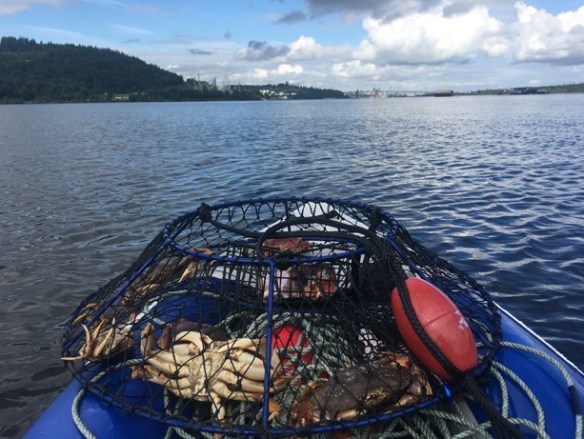
A small batch of Dungeness crabs caught off the Vancouver coast. Photo courtesy of Jay Santos.

By Tom Schlichter

We’ve seen some interesting ways to put Sea Eagle kayaks to good use, but this one from Jay Santos, of Vancouver, British Columbia, Canada, is truly unique. Santos uses his Sea Eagle 300x Explorer inflatable kayak to catch Dungeness crabs, which he then sells to co-workers and friends.

“I actually got started when a buddy told me he enjoyed catching crabs in tidal waters from his paddleboard” explains Santos. “One day we went out for a paddle and he showed me how it’s done. He offered to lend me one of his crab traps to give it a try and I pulled six shorts and two keepers on my first haul. I’ve been hooked on crabbing from my Explorer 300x ever since.”

At first, Santos worried that it might be too much work to lower and raise the hoop-style traps in the 50- to 80-foot depths where he’s had the most success. He was also concerned that sitting so low to the water might make the task even more difficult by taking away the leverage advantage of standing that his friend had on the paddle board. But things went smoothly right from the start said the 56-year-old store coordinator of medical supplies at Vancouver Hospital, who now has a regular route of acquaintances awaiting his deliveries. Interestingly, Santos isn’t a seafood lover himself, which, he says with a chuckle, makes it easy to part with his catch at day’s end.

Only the best will do. Photo courtesy of Jay Santos.

“The combination of crabbing and paddling has really made a difference in my life,” reveals Santos. “It’s been a great way to get outdoors and have some fun, especially during the COVID-19 pandemic. All the work and exercise has helped me melt away a few pounds, too. I don’t even realize the weight is coming off while I’m crabbing or covering water on my kayak, and the workouts make it easy for me to sleep at night. So, this has been more than a business venture, it’s really a life-style choice. When I called and placed my order with Sea Eagle, the salesperson told me: ‘You won’t regret this,’ and he was absolutely right. I’m definitely satisfied with my purchase.”

To be sure, Santos was interested in buying an inflatable kayak before he thought about crabbing, and he eventually took the plunge after doing considerable research online. He described his first purchase, from another manufacturer, as “boring” since it had been designed mostly for getting out on placid ponds. Eventually, he discovered Sea Eagle and was immediately intrigued by the 300x Explorer because it seemed rugged, stable and river ready. Additionally, it was rated for tackling up to class 4 rapids, and some reviews even mentioned using it for surfing. “I watched a ton of You-Tube videos on this model,” he stated, “and it just looked like a true multi-purpose kayak that could be a lot of fun.”

Santos does his crabbing along the Vancouver coast, spending time around Jericho Beach, Burrard Inlet and at Deep Cove in the Indian Arm waterway. “I love it,” he says, “but this is hard work. I use Promar Ambush, 32” diameter hoop style crab pots and they weigh about 5 pounds each. When you pull the rope, the sides rise up and the crabs tumble to the center of the pot. I check my traps every 30 or 40 minutes. We’re only allowed to use two crab traps at a time, and a license is required. While my traps soak, I head for the nearest beach or cove.”

Batch of Dungeness crabs just out of the water. Video courtesy of Jay Santos.

That down time between pulls is what Santos calls his special time. “Exploring is what having a kayak is all about. I love looking at maps and deciding which new places to check out. We bring folding chairs, which is fine because the 300x has plenty of room for those, plus my pots and provisions. I put the pots in the bow where they receive good support from the deep pontoons. I never feel squeezed in this kayak because it has lots of leg room. It’s also exceptionally rigid and stable, and it tracks easily in the water thanks to its removeable skeg.”

Another plus for Santos is the Explorer’s toughness. He’s scraped it on barnacles, dragged it across rocks, and bumped it against docks and says it holds up remarkedly well in rugged conditions. It sports self-draining valves – which are key for running rapids or paddling on the ocean – and has D-rings for securing gear. “I attach my paddle leash to a D-ring so I can simply dump the paddle on the side of the kayak when I need to pull a trap,” he says.

Taking a break and enjoying the view from shore. Photo courtesy of Jay Santos.

Of course, like most who own Sea Eagle inflatables, Santos appreciates that the Sea Eagle 300x inflates in less than 10 minutes and can be left inflated for several days if necessary. They’ll fit easily in a closet or garage and can be placed in a car trunk or on a car roof for transport. In fact, Santos often leaves his kayak inflated for the ride back home so it dries before he gets  back. At that point, a good wipe-down is all it needs before being deflated and stored.

“There’s one other thing I really love about this ‘yak,” concludes Santos. “It’s great to loan to friends. Most are hesitant to try it at first but once they see its’ easy to get in and out, and has plenty of leg room, they hop aboard and head right off. It’s a great feeling to see them paddle out and start having fun.”

TIMING IS EVERYTHING WITH THE PACKFISH7™ AND SEA EAGLE SPORT KAYAK SE370

Little-Dell-New-Raft

Sea Eagle’s PackFish7™ is lightweight, easy to transport and remarkably steady making it the perfect choice for Larry to target lunkers well off the beaten track.

For Larry Lutton, the release of Sea Eagle’s new PackFish7™ couldn’t have come at a better time.

“I was just about to buy a float tube and kicking fins when I saw an ad for the new PackFish7™, which had just been released. What a break that turned out to be. I’m so pleased the way things ended up.”

Lutton, 69, loves to fish in the beautiful rivers, lakes and reservoirs around Salt Lake City, Utah. He regularly targets rainbow, brown, brook and tiger trout on these waters with both fly-fishing and spinning gear and now his new PackFish7™ gets him off the shoreline, out among the lunkers in comfort and style.

“I have a bad back,” explains Lutton, “but I’m able to transport, inflate, launch, paddle and break down my PackFish with no trouble at all. It’s easy to row and the four tracking strips on the bottom keep it going straight ahead so it isn’t easily blown off course by the wind. The entire boat weighs a very manageable 32 pounds – with the floor board inserted! Packed away, it fits in my Mini Cooper for easy transport so I can head up to my favorite lakes and reservoirs for a day of fishing. If you purchase the optional back straps, it is very easy to hike into the lake after the PackFish has been inflated, even with the floorboard in place. It takes only five minutes to inflate everything using the foot pump and the two side pouches have enough room for extra tackle, fly boxes and water bottles.”

Pack-Fish-7-and-the-370-packed-&-ready

Lutton’s PackFish7™ and SE 370 both fit right on top of his Mini Cooper, making them ideal for a quick and easy getaway to his favorite mountain rivers and lakes.

About those floor boards: Lutton loves them!  “It adds a degree of stability and safety that other inflatable rafts don’t have,” he states. “I’ve had inflatable rafts before and getting into them is like stepping onto a waterbed. With the PackFish7™, I can get in and out very easily and actually stand-up and fish if I want to.”

Most of the time Lutton prefers to fish from a seated position and that, he says, has worked just fine so far because the seat rides high enough to be comfortable while also providing a good look into the depths below. “I spent three hours sitting and fly-casting the other day and my back felt great,” he added. “Everything about his boat is well thought out. There are two big pouches for storing gear, two rod holders, and the oars can be left hands-free or secured to the side with hook & loop closure straps when I’m casting and landing fish. The PackFish7™ is comfortable, stable, lightweight, easy to maneuver and – unlike conventional float tubes and kick boats – you stay dry! I really think the Pack is a terrific choice for anglers of any age – even old-timers like me.”

this is the reason why. rafting in the beautify Uintas

With his new PackFish7™, Larry Lutton can now easily get off the shore even in remote waters, expanding his opportunities to connect with trophy fish.

Lutton, it should be noted, is no stranger to Sea Eagle products. He also owns a SE370 kayak, which he takes out paddling with his wife, Carol, and their friends who introduced them to the SE370. “What my wife likes about the Sea Eagle is how stable it is,” he explains. “Unlike hard shell kayaks and canoes, you never feel like you are going to roll over. The inflatable floor makes it easy to step in and out of as well.”

“We also like that the seats on that inflatable kayak have flexible positioning – so my wife and I can adjust them to fit our own needs even if we switch places during the course of a trip. With only one seat it is still easy to paddle and makes for a great one-person kayak.”

Lutton_spoiled-fisherman

In addition to the PackFish7™, Larry Lutton also enjoys family time aboard his SE370.

Lutton hopes to squeeze in a lot of fishing and paddling over the remainder of the summer and fall seasons. “With my new PackFish7™ I can cover a lot more water than I could in a float tube,” he says, “…..and I plan to take full advantage of that opportunity. My first love is fly fishing streams and rivers, but the PackFish will get me out on my favorite little lakes in the Uintah Mountains for some still water fly-fishing that was otherwise difficult, if not impossible to do from shore.”