Mike M. isn’t one of those guys that was born with kayaking in his blood. In fact, it was just in the past few years that the retired auto mechanic, an Arkansas resident, first realized he really liked paddling.
“I got into kayaking because my girlfriend liked it,” says Mike. “We took a trip together down the Buffalo National River in a canoe a couple of years ago and I graduated from there. When it came time to buy my own kayak, I purchased a Sea Eagle 370 inflatable kayak. Now I absolutely love it. We started with some short and easy local flat-water trips and eventually progressed to more challenging, longer trips. At this point, I can tell you that I’m really putting my SE370 to good use. I’ll head out with my girlfriend or my dog, and often spend a full day or more on the water.”
How did Mike end up in a Sea Eagle Sport Kayak? He did his homework before making his purchase. “I liked what I read about the 370 being stable, rugged and having a 650-lb. load capacity,” he says. “At just 32 pounds, it’s also very portable -and it won’t stick out the back of my truck like a hardshell kayak would. That lightweight and extra portability are key factors for me as I have a bad back. I also like that this kayak is easy to blow up. In fact, you can do it in less than ten minutes because it has a one-way valve that prevents the air from coming back out as you pump it up. It also fit my budget, which is usually pretty tight. It’s a three-person kayak, so I can bring my girlfriend and my grandson along when I want, but mostly I go with my dog.”
Mike isn’t a serious angler or thrill-seeker, although he does enjoy riverbank camping. While he’ll challenge himself with an occasional run that sports class I or II rapids, he generally prefers to paddle and drift along while breathing in some fresh air, checking out the sights and taking pictures of wildlife. Given a choice, he tends to head for places where there isn’t too much traffic on the water, and really appreciates having the ability to get off the beaten track when feeling the need for a change of scenery to help him relax.
“I got my 12’ 6” Sea Eagle 370 Inflatable Kayak last June when a lot of the rivers around here were still pretty low, so I kept things local in the beginning,” says Mike. “Eventually, though, I moved up to some bigger waters like Big Piney Creek, the Mulberry River, and then the Buffalo National River. That last spot is where I did two different trips recently. The first one covered 31 miles in two days and the second saw me go 43 miles in three days. It was just me and my black lab, Sassy, on those trips. Both ventures were nice, quiet, and relaxed. The 370 is terrific for these longer trips because you can load it up with plenty of gear. I’m a big guy and I tend to pack heavy with a dry box and a couple of duffel bags, but my Sea Eagle is always up to the task.”
In terms of the 370’s toughness, Mike noted that he has on several occasions run it through or dragged it along shallow, rocky waters and he even tested it in class three rapids. “There are two passages through the Sacroiliac Rapids on the Mulberry River,” he explains. “On one trip there, the safer (suggested) route was too shallow and rocky, so I decided to go through the rapids. The current put me right up against a big boulder but I managed to push away unharmed. My 370 really did a great job with that brush-up and I’m thankful I didn’t flip. I later found out a kayaker died there a year ago so next time I encounter a similar situation, you can bet I’ll shoulder my vessel and walk around.” Two other features of the Sea Eagle 370 Inflatable Kayak that Mike enjoys are its ability to track exceptionally well and speed along at a fast clip. He made good use of both abilities on his last venture down the Buffalo National River when it started to get a little busy.
“There were a lot of kayaks on the water since it was over Memorial Day weekend,” recalls Mike. “Some people had boom boxes blaring, too. I just paddled right past a bunch of them – even a few in long, skinny hardshells designed for speed. In just a few minutes, I managed to put some distance between myself and the crowd and was off to find some quieter waters. That actually turned out to be fun, passing all those other paddlers. I must have been moving at three or four miles per hour. That’s rather good for any kind of recreational kayak on a flat-water stretch.”
Most recently, Mike headed out on a yet another Buffalo National River trip, this one starting in north Arkansas, at the Lower Buffalo Wilderness area, which is the most remote part of the river and includes some rapids near Clabber Creek. The entire run, says Mike, covered 30 miles.
“That trip took three days because I didn’t get on the river until 5 p.m. and had to camp after about four miles. Still, it was pretty easy to do 17 miles the next day, and then finish up the trip in the morning on day three. I can cover 15 miles a day with no problem in my Sea Eagle 370.”
Mike reported that his top speed on this adventure was just over 8 mph in the faster flows, and 3 to 5 mph in the calmer waters and flat stretches. His average speed for the full trip was 3.5 mph according to the GPS and total run time was 8.5 hours.
“I don’t think I could expect any better from a paddle-powered vessel,” reveals Mike. “The 370 handled the rapids very well. It’s very forgiving and makes me feel safe when I’m out in the middle of nowhere with no cell service and little chance of rescue if something goes wrong. I think Sassy feels safe on these trips now too, as she doesn’t rock the boat and stays right in the middle of her seat most of the time. She is becoming quite the river dog.”
As for the future, Mike says he plans to continue exploring bigger and more challenging waters, and that he’s really looking forward to seeing what each holds in terms of wildlife along its banks. So far, he’s covered nearly 250 miles in his Sea Eagle.
“Some neat things happen when you kayak,” he reveals. “I see a lot of eagles, and I recently had a heron fly by me with a snake in its mouth. Too bad I wasn’t holding my camera for that one. It would have made one heck of a show.”
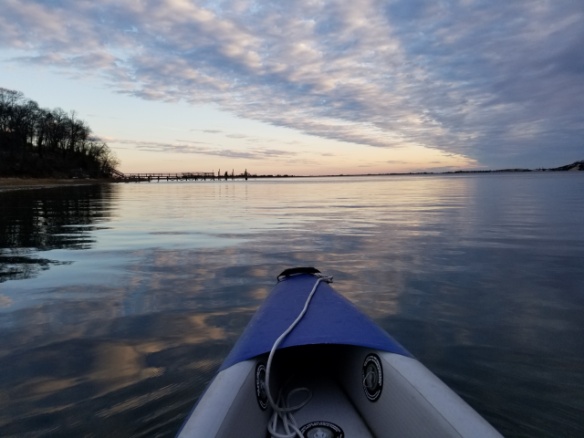
March 14th – As I paddle out into Port Jefferson Bay the morning sun is blocked by a cloud bank. Soon the clouds will clear and the sky will be blue. I consider myself lucky to be out on the water enjoying all this while a Pandemic makes its way across America.
By Cecil Hoge
March 14, 2020
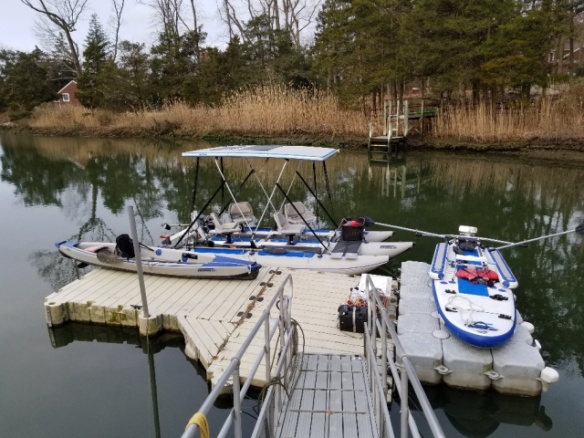
On this Saturday, I took the opportunity to go for an early morning paddle. That is easy for me because I live by the water and have a dock about 100 feet from my back door. So all I have to do is walk out of my living room onto my back porch, walk down a few stairs and go another 100 feet. I am then on my dock where I have several inflatable boats at my disposal. On this day, the water on the bay is flat and glassy, the sky is still and has a large bank of clouds off to the Northeast. The temperature is around 45 degrees Fahrenheit and the sky is still reflected in the shimmering tones on the glassy water.
Today, I choose to paddle my RazorLite kayak. I have a choice: on my dock, I have a kayak and a rowing craft, I also have a solar-powered electric motor craft I call the TriTiki. I use the TriTiki to cruise around our bays on warmer days. Today is not one of those days.
When I use my kayak on chilly days, I also use a kayak blanket that we sell for that occasion. I like to be warm when paddling a kayak and since my legs do not move when paddling that blanket comes in mighty handy for when I want to be toasty warm.
Out on the water in my kayak, the air is clean and wonderful to breathe. Soon, I know, the winds will pick up out of the Northwest. Then the clouds will move out and the sky will be fully clear. And with the sun will come some extra warmth. No matter, I am well dressed for the occasion with gloves, a windproof fleece-lined nylon jacket, and a warm wool hat with earmuffs. I am, as always, totally warm and comfortable.
I paddle out past the old stone bulwark that used to lead to a wood bridge that spanned my bay (Little Bay) and leads to Setauket Bay. The wood bridge is gone since 1898 when I assume it was washed away by a ferocious storm. On this tranquil morning, I am wondering if I am paddling in an allusion – if this calm and beautiful scene is but a dream. Perhaps, in reality, I am paddling in an unseen and silent storm.
The broken-down stone bulwark is still quite close to where I started, so I do not feel that I have exerted much effort. It is the beginning of my paddle. I am in no hurry. A little further along a line of 7 Canada geese proceed out in front of me from the shore. I steer a little further out in order to give them space and time to figure what they want to do. I know either they will get all excited and start barking at me or they will change course and paddle their webbed feet back towards shore.
I am hoping they will not get excited because they make a terrible noise and the end is always foreseeable. They start barking, then their barking becomes louder and occurs faster and then they all fly away barking as they go. But on this day, they have wisely chosen to change course, stay silent and cruise back toward the shore.
March 15th, 2020
Here is my prototype rowing craft, rigged with all the comforts of home, thermo-bag with seltzers, cushion for the seat, mirror to have an idea of where I am rowing and a life jacket.
On this day in old Setauket (it was first settled in 1665), the weather is clear and reasonably warm for the time of year. I choose to use my rowing craft this day. This happens to be a prototype of a new kind of inflatable boat that I am tentatively calling the GoSkiff. Originally, I designed it to accommodate a sail, which I tested at the end of last summer. It sailed quite well, but with the advent of colder weather and winter, I converted it to a rowing craft, using my friend Urs Wunderli’s sliding rigger arm. I have been using this sliding rigger arm for 5 years now. Urs calls it “Row Board” and sells it on his website: DiscoverRowing.com. I consider “RowBoard” an uninspired name, but the product is truly great. I have told Urs to rename it the “Wunderli Rower”. So far, Urs has ignored my suggestion.
A sliding rigger arm is similar to a sliding seat, except instead of the seat going back and forth, the rigger arm holding the oars goes back and forth. In truth, a sliding rigger arm is actually more efficient. I won’t go into all the details. Both systems improve the ability to row. What I like about rowing is that it provides a total body exercise. That is because your arms, your legs, your hips, your stomach, your back are all in motion. Rowing provides another advantage over paddling in that you are naturally warmer because all parts of the body are moving…so no need for my trusty kayak blanket.
Rowing is different from paddling in that you see where you have been, rather than where you are going. It also is a form of exercise that seems to feed on itself. Simply put, there is NOT a tendency to stop and smell the roses, so to speak. Rowing seems to promote an exercise rhythm that becomes addictive. Once you start rowing you really do not feel like stopping. That does not mean you do not take in the sites…you do. The difference is that you usually row steadily for a long time, not wanting to slow down, but still seeing the sites as they pass into vision. And yes, after rowing steadily for two miles or so, I do stop and secure my oars. I then float silently on the water as the wind blows me where it wishes and I take in the sites while I chug down a seltzer. The sparkling water is surprisingly refreshing after rowing 2 miles.
I characterize paddling as lollygagging whereas I characterize rowing as rowing. Paddling is lollygagging in the sense that there is always the temptation to stop paddling, take a deep breath and take in the scenery that is always in front of you. And in fact, that is one of the most pleasurable aspects of paddling.
On my many paddling or rowing journeys, I see many interesting sites…loons diving for fish, hawks circling high in the sky, seagulls clustering over a school of minnows, elegant white swans cruising nearby with young brown-tinted smaller and younger swans in tow, a seal popping his or her head out the water to check you out. Now, these sites occur at different times of the year and some are far more often than others. I see seals only a couple of times in the year, always in the dead of winter, although two years ago a baby seal took up residence on my dock – see below:
Here is an overnight guest that came one winter day. I did not charge this youngster a residence fee for the night.
On this Sunday I take my rowing craft, tentatively called the GoSkiff 14. As I mentioned, with rowing you see where you have been. Now I have to confess that I cheat. I have installed a mirror on my rowing craft. It allows me to see most of where I am going – my mirror does not have Xray vision through my body so I have to be careful. That still does not prevent me from occasionally running into a buoy or a boat. At this time of year, all buoys and boats have been removed from the harbor except for one rather large fishing vessel named the “Lisa Jean” that floats by itself in Setauket Harbor as a reminder of the fishing fleet that once was moored there.
So, off I go, rowing as I wish through the different bays. Paddling or rowing these days is practicing social distancing in the extreme. There are no other paddlers, rowers or boaters on this day or, for that matter, on most of the days during the late fall or winter. So, I usually have all the bays to myself. When I go rowing in the winter, I wear fleece-lined pants which keep my legs toasty as they push back and forth. As I have mentioned, I like to be warm and, if you dress properly, you always are. I would mention here for those concerned about my safety and boating regulations I always wear or carry a life jacket, so worry not, I am safely ready for my journeys on the sea.
It is another wondrous day on the water even though there is a chilly breeze. I carry other equipment with me that I consider vital. If it is an early morning, I carry hot coffee in a Yeti mug. If it is later in the day, I carry a couple of seltzers in a thermo-lined bag. At this time of year, the thermo-lining is not required, but the bag makes it convenient to carry the seltzers. So, on this sunny and clear March day, I row out past Little Bay, past Setauket Bay and into Port Jefferson Bay, the largest of our four bays. Here I can take a break, pull out a seltzer and take in the view. It is a good day to be alive.
Social Distancing at its Best
March 16th, 2020
And so, while America deals with closing schools, bars and restaurants, I intend to paddle or row the waterways of America. From my dock, I can paddle into a small bay appropriately called Little Bay. From Little Bay, I can paddle to the Atlantic Ocean.
Of course, paddling from my house to the Atlantic Ocean is something of a jaunt. Long Island Sound is about 5 miles from my house, but the Atlantic Ocean is another 60 miles to the East or the West. One has a choice when coming out through the inlet into Long Island Sound to go West towards New York City through the East River into the Hudson River into the Atlantic Ocean with New Jersey just on your right. That’s a good choice if you want to paddle on to Miami. If you decide to go East, all you have do is paddle 60 miles East and pass Montauk Point and then you can head to Block Island or further north to Maine if that is your fancy.
Needless to say, I restrict my paddling to the 4 bays that are most directly accessible from my dock. I failed to mention the fourth bay which is called Conscience Bay. It is off to the right as I come out into Port Jefferson Bay. Anyway, I think you get the idea that I have a lot of options, even if I don’t take them all. But paddling or rowing are the main options that I choose to ward off the sad events of the Coronavirus in America.
March 18th, 2020
I go for a very early morning row. It is mostly dark when I leave at 5:45 am. The water on the bay is a flat black glass. The moon is still out and it sports an unusual halo this early morning. I do not know what the halo portends. It seems strange. In the distance, there are lights from the surrounding houses that circle my different bays. In the dark, I hear garbage trucks making dinosaur screeches as they stop and pick up cans. Today is plastic day. The town of Brookhaven (our township) has announced that it can no longer recycle the plastic they are picking up. I wonder where the plastics will go.
Here is what I see on the bay:
The darkness before the dawn is fading. Soon the sun will erase the moon and spread its light over all.
I row out of Little Bay into Setauket Bay and then into Port Jefferson Bay. The dim light of the day gives way to a clear blue expansive sky and soon I can feel the first warmth from the sun. The wind is out of the Northwest about 10 mph and as I come out of Setauket Bay, it pushes against my back as I row forward. When I get to the mouth of Port Jefferson Bay, I take a break, put up my oars, sip my still hot coffee and ponder the new day.
After a few minutes of contemplation, I pick up my oars and resume my journey. It is easier to row back since the wind is now pushing me in that direction. As I come around the bend in Setauket Bay, I row along the Strong’s Neck shoreline. I am now protected from the wind because I am in the “Lee of the Land”. And while I always dress warmly, the extra warmth that comes from the rising sun in an area protected from the wind is much appreciated.
March 20th, 2020
This day is sunny and warm, with temperatures making into the 60s. I take the opportunity to go for a morning paddle.
March 21, 2020
Since the weather is sunny and a pretty comfortable 52 degrees, I head out for a paddle on the bay. I encounter no other paddlers. It is still early for most kayakers to get out on the water. I take my trusty kayak blanket to keep my legs warm and dry. The dry part is an especially handy feature because of “paddle drip”. This is something that most kayakers never mention, but water tends to make its way down the shaft of a paddle blade and drip into the cockpit of the kayak. But no worries for me, my trusty, toasty waterproof kayak blanket keeps me both warm and dry. It is a good day for a paddle and I come back feeling refreshed and happy at the news that we can continue operating.
March 27, 2020
The weather on Friday was clear and in the low 50s. I take the opportunity to go for a paddle and ponder the state the world with a wide expanse of blue water in front of me.
It was a beautiful day and a wonderful paddle. The air was fresh and clear and I saw no one during my paddle. It was just me, some seagulls twirling around in the sky, some swans cruising elegantly by me, some great blue herons standing on the shore looking on at me in disapproval. I can tell you from experience herons, especially great blue herons, don’t like humans. They consider us interlopers on this earth.
The weekend comes and with it some nasty, rainy, cold weather. I stay home and light a fire. It gives a cozy and toasty feeling for me and my family.
March 31st, 2020
This Tuesday morning I choose to go for a row. That is both practical and smart. It is a cloudy, cool morning with a heavy bank of clouds stretching above as far as the eye can see. The temperature is around 40. The wind is out of the Northeast blowing at steady, cold and unforgiving 10 to 15 mph. My decision to row rather than paddle is practical because my kayak has gathered about 3” of water since I last used it. When I go down the dock, the first thing that I do is undo one of the drain valves on my kayak and drain out the water. Then I close the drain valve and flip the kayak upside down so no more rain can come in and the kayak will dry out.
“The Fleet” at my dock – a water filled Sea Eagle RazorLite to the left, a prototype “GoSkiff 14” on the right, a prototype “TriTiki” on the far side of the dock. The “”TriTiki” is 16’ long, holds up 4 people and features 2 solar panels, 2 lithium batteries, 2 electric motors. The solar panels charge the batteries, the batteries power the electric motors. The Green Revolution is in place at my dock.
My decision to go for a row is also smart because the kayak seat, having rested in 3” of water, is not going to be either warm or dry. So I then get on the other floating dock holding my rowing craft, slide it off that dock and get on my “GoSkiff” after I place a dry seat cushion on it. Fully prepared now, I begin my row out of Turtle Cove (my name for my little cove) and ply my oars into Little Bay. As mentioned above the temperature is still pretty chilly, the wind right nippy coming out of the unforgiving Northeast. Someone forgot to tell this March that it was supposed to go out like a lamb.
In Little Bay, I hug the shoreline which means closely passing by the cemetery that is at the end of the road my house is on. Appropriately, my road is called Cemetery Lane. The cemetery houses many folks from the Revolutionary War. Strong’s Neck, where I live, was settled in 1655 by the Smith and Strong families. And many family members are now buried in this nearby cemetery. I stay close to the cemetery and the shoreline because it keeps me in the “Lee of the Land” and thus I am sheltered from the nagging Northeast Wind.
I ply my way along the shoreline on this gray and cloudy day, happy almost instantly to be out in the clean refreshing air. I come around the stone embankment and pass into Setauket Bay & Harbor. Immediately, I run into the 10 to 15 mph Northeast wind. Now I can row quite easily through that. Because I am rowing directly into the wind and my back is facing the wind, I am quite shielded, thanks to my trusty Duluth Nylon fleece-lined jacket. I can plow through winds pretty efficiently up to 25 mph, but after that, I prefer to let others try it. Rowing in 25+ mph winds is a younger man’s game.
I read that Teddy Roosevelt when he was a boy, loved to row in Long Island Sound in high winds. Teddy was a sickly child and not strong, but as he got a little older he took up outdoor exercise with great relish, his theory being that outdoor exercise would help him overcome his early sickly disposition. It seemed to work. He went on to become a very energetic President of the United States. Teddy grew up in Oyster Bay about 21 miles west of here.
Here be the “Lisa Jean”. Maybe the last of her kind in Setauket Harbor. Two crows sit at the stern on this cloudy and chilly day. Here the wind is sheltered by the land on both sides of the bay. Just seconds before there was a seagull on the bow. He or she flew away, perhaps, afraid that I might digitally capture their soul.
I am not rowing in high winds on Long Island Sound today. Good thing too, because it would probably mean rowing against sizable whitecaps. I am rowing in brisk Northeast winds as I ply my way through Setauket Bay and Harbor. Pretty soon, as I row into the narrows of Setauket Bay, I come up to the one boat that is still moored in the harbor. It is the “Lisa Jean”. She stands as a lonely reminder this once was a working harbor, a place from which whalers set out into the Atlantic and Pacific oceans in search of whales and whale oil, a place where fisherman and clammers and oystermen once made their living.
The “Lisa Jean” is moored about a half-mile from Port Jefferson Bay, so this is about a one and half mile row from my house. I take a picture of the venerable fishing craft and row my way around it and head back home. It is not my longest row by any means, but it is enough of a row to get a full slug of fresh air and to be reminded that the real world is outside, not inside. I am hoping, like Theodore Roosevelt, that my paddling and rowing activities will bring me true peace of mind and strengthen my body. While I am at it, I also hope that it will protect me against the Coronavirus.
Back on my dock, I walk up my dock gangplank and look back over my little cove and the bay beyond. I cannot help but think it is a beautiful morning.
Author’s Note: The above story is an abridged version of a longer blog published on my personal blog site. The longer version discusses in addition to paddling and rowing, the progression of the Coronavirus, and other political and economic conditions. Should you be interested to read the full version, click on TangledTalesofanAmericanFamily.com
Testing of new models came to be an ever-expanding way of life. Often this meant testing products when most folks would be inside sitting before a fireplace. Here I am testing our then new model Sea Eagle FastTrack. My rule for testing in the winter was, “Do not go out when the ice is thicker than a 1/4”.
By Cecil Hoge
At the end of part 2 of this history, our Sea Eagle boat business had already been in business for 30 years and gone through many changes. By 1998 we had re-built our Sea Eagle boat business and had found new ways to sell more inflatable boats through our new Sea Eagle website. In doing so, we expanded our range of products to include transom boats, whitewater & camping kayaks, fishing boats and a new kind of inflatable catamaran kayak called the Sea Eagle PaddleSki.
From our earliest beginnings in 1968 to the present, our goal was always to produce the best inflatable boats of their kind. In doing that, we always tried to offer products that were different and better from what was on the market, whether it be a kayak, a fishing boat or a transom boat.
So, for example, when I developed the FastTrack shown above, it had several unique features not found on inflatable kayaks. Its most unique feature was the patented outside drop stitch inflatable keel. That gave the FastTrack special paddling benefits. As the name implies, it paddled faster and tracked better than other inflatable kayaks.
There were other differences in the FastTrack that made it unique: it had a drop stitch inflatable floor inside, on top of an outside fabric floor. That provided rigidity and great puncture protection. It had an asymmetric shape – tapered at the bow, wider at the stern. This allowed the kayak to go through wind and waves easier and still hold the weight of two people comfortably. It had an outside removable skeg to further improve tracking. These design features made the Sea Eagle FastTrack our best paddling inflatable kayak for open water ever.
As we moved into the internet age, the goal of the company remained the same: produce the best inflatable boats of their kind.
Unlike our Panther Martin fishing lure business, which had enjoyed continuous growth from 1958 to 1998, Sea Eagle Boats had both up and down years from 1968, the year we started in the inflatable boat business, through 1998. These ups and downs were mostly caused by external factors such as suppliers going out of business or big swings in foreign currencies or dramatic price rises in the price of petroleum. The price of oil was always a major factor in our business because inflatable boats are made from petroleum based fabrics and parts.
I have to point out that we have always worked with foreign suppliers to make inflatable boats because there has never been an inflatable boat industry in the United States. We did make two experiments with production of inflatable boats in the U.S. We had a Michigan company produce some transom boats for us for a short period and a Delaware company produce some kayaks for us. The transom boats made in Michigan were actually pretty good and almost succeeded, but we were defeated when the company went bankrupt, primarily because they had grossly miscalculated their true costs.
The kayaks made by the Delaware company were an interesting case since that company happened to produce the space suits that were used for the first trips to the moon. I assume this company was and still is an excellent producer of space suits. I believe they are still the main supplier of space suits to NASA. Unfortunately, they proved to be a terrible producer of inflatable kayaks.
The Sea Eagle Explorer Kayaks that they made for us in the late 1970s turned out to suffer from slow seam leaks. Admittedly, the leaks were so slow that it took weeks for a kayak to become soft. And it actually took some time after receiving the first kayaks to understand that there was a slow seam leak problem. We probably could have solved that problem in future productions, but another more difficult issue arose.
This particular company was used to selling to the government and within a few weeks of starting production of our kayaks, they found making kayaks took far longer than they thought. So, they did what they always did with the government. They announced to us the necessity of immediately increasing the price. They had a hard time understanding why we were unable to accept a 60% price increase mid-production during the first run of 200 kayaks. They also had a hard time calculating the time, labor and material costs involved in inflatable boat production.
That is because inflatable boat production requires an extensive manufacturing experience and the local availability of parts, materials and machinery. The inflatable boat industry, which first arose in Europe and then migrated to Asia, has a long history of manufacturing and extensive infrastructures in Europe and Asia to support it. To duplicate a factory in the United States capable of making inflatable boats would require an inherent understanding of manufacturing techniques that are unique to the inflatable boat industry and a network of supplier companies to provide parts and materials needed for production.
As a small family owned company, we have always wanted to produce our boats in the United States, but every time we researched what was necessary to create an inflatable boat factory here we came to the conclusion that the startup costs were far more than potential sale of boats that we could expect.
Why is it so difficult to manufacture inflatable boats in this country? First, and this is a pretty big first, there are no real producers of inflatable boat material in the United States. Yes, there are a couple of companies producing fabrics that say their materials are suitable for inflatable boat production, but the cost of the hull material is usually 5 to 6 times a similar hull material in Asia or Europe and the actual characteristics of the material are not suitable for inflatable boat use. For example, PVC/Polyester, the most used material for inflatable boat production, the U.S. version of the material had a tendency to be too rigid to easily roll up. An interesting alternative material, Urethane/Polyester, tended stick to itself and be 10 times more expensive than PVC/Polyester.
So, problem number 1 is finding a U.S. company able to produce a suitable hull material at an economical price and as far as I know that does not exist.
The second problem is finding parts suitable for inflatable boat production. And that is also an almost impossible problem, because there are no companies making the valves, the grommets, the carry handles, the multitude of fittings you need to outfit inflatable boats. Again you need all those parts and fittings in order to make an inflatable boat. An inflatable transom boat, for example, without the molded parts to glue the wooden transom on, is not an inflatable transom boat. It is like a fishing lure without a hook.
This is also the case with inflatable kayaks, where for example, D-rings and drain valves are important parts, or inflatable standup paddle boards (SUPs), where drop stitch material is necessary in order to achieve the required rigidity of a SUP.
Drop stitch construction is a particularly interesting example. It is a relatively new development in inflatable boats, kayaks and SUPs that allow you to make flat, rectangular shapes with high pressure. This new material greatly widens the shapes and kinds of boats, kayaks and SUPs that you can make.
Drop stitch material consists of two layers of fabric with hundreds of thousands of threads going from the bottom layer to the top layer. When inflated the threads prevent the material from becoming a round shape. Without the hundreds of thousands of threads between two layers of fabric, the fabric, when glued together, will want to become a round shape when inflated, which while very useful for many purposes, limits the shapes you can make. Thus, the advent of drop stitch manufacturing technology is an important advance in inflatable boat production because it allows you to create unique new shapes previously not possible. This type of construction permits much higher air pressures making drop stitch products far more rigid than other inflatables.
This is our patented 16′ Sea Eagle Travel Canoe – drop stitch technology makes it possible to achieve shapes previously impossible.
This technology is not very new. I first saw it being used in France about 45 years ago. At that time, the technology was quite unreliable and subject to defects…so having a basketball shape suddenly appear in the middle of what was supposed to be a flat shape is not very good. In the last 10 years the technology of making drop stitch materials has advanced enormously and today it is probably the greatest innovation in inflatable production in the last 50 years. As such, it is pretty necessary to have the ability to produce drop stitch constructed inflatable products.
Unfortunately, there is no American producer of drop stitch material. If you want to use this type of material and make boats in the U.S., you must import the drop stitch material. The only countries that can make drop stitch hull fabric for inflatables are Germany, Japan, Taiwan & China. Of these countries, China produces both the best quality drop stitch material and best priced drop stitch material. Sad but true.
So, for the above reasons, we have always worked with foreign companies to produce inflatable boats and as time went on, those companies were generally located either in Korea or China.
By the late 1990s, as mentioned above, we were producing Korean and Chinese made inflatable boats made to our specifications and design. Our supported fabric boats were made in Korea – those boats use a fabric re-inforced PVC/Polyester material. Our unsupported PVC boats were made in China – we use a special formulation, extra thick PVC material we call PolyKrylar™ for our Sea Eagle 330, 370, 9 and PF7.
By the late 1990s, because of the advent of the internet, our inflatable boat sales assumed a steady and growing pattern of increases year after year. So unlike our early sales from the 60s to the mid 90s, where sales on any given year could be up or down, sales from 1997 on went in just one direction: Up.
Our website, SeaEagle.com, and the internet introduced many new possibilities. As mentioned in Part 2 of this history, we started very simply on the internet in 1996. Just a few display pages and an 800# that customers could call. It did not take us long to realize that having an order cart was important, both for orders during the day and for orders at night. By 1998 we had an order cart and internet sales, along with overall sales, were growing rapidly.
The internet allowed us to also explain products in ways previously not possible. Not only could we put far more content on the internet about a given product, but we also could show videos. This was a giant jump for us because for the first time customers could actually see our boats in motion.
Previously we had made various videos, but they were to show on a TV program or in TV 60 second commercial or on a TV screen at a boat show. There were limited places we could use these videos. But now that we had a website, we could post videos permanently on the website and those videos would stay up as long as we were selling the product. And, given our history, that turned out to be a long time.
The background of increasing sales was a new and wonderful aspect of our business. It meant then that we could introduce many new models, put them up on the internet and have sales of new products pretty much as soon as they arrived in this country. And, because we still were making and printing catalogs showing the same products, this in turn supported the new and additional side of the business coming from the internet.
This is our patented Sea Eagle FoldCat – a roll-up fishing boat that you can assemble and inflate in less than 10 minutes. In the background — the breathtaking Grand Tetons.
So after successfully introducing transom boats (our Sea Eagle 10.6, 12.6 and 14 models), we went on to design and introduce FoldCats and PaddleSkis. These were two truly unique boats. The FoldCat being a patented two man fishing boat that could be set up in less than 10 minutes and the PaddleSki being a catamaran kayak that could be motored, sailed, paddled or rowed. Each of these new models did extremely well, selling hundreds and then thousands.
In addition to introducing new models, we also were able to bring back older classic sellers such as our Sea Eagle Explorer kayaks. These were great whitewater, camping, all around kayaks that I had first developed in the late 1970s. Because our Korean supplier had access to better materials and new manufacturing techniques, we could remake this series, improving both the original design and the original materials.
By the 2000s, we had fallen into what I would call a “virtuous circle”. We could grow sales of our products with print advertising, catalogs and the internet and when we added new products we could add new sales to existing sales. This meant that in those years we basically quadrupled our sales.
Through these marketing techniques, we were able to become the first company on Google when you typed in “inflatable kayaks” and generally in the first five companies when you typed in “inflatable boats.” All of our marketing efforts were tied together, so print ads listed an 800# and our website, catalogs gave our in house order telephone # and our website and our website also gave our in house order telephone number and had a place to request printed catalogs.
So you can say our success was a combination of constantly introducing interesting and unique new products and then using print advertising to tell the public about those new products, and then using the internet and catalogs to show those new products and being able to take orders night or day on the internet and being able to answer any and all customer questions or take orders on our in house 800 phone number. It was indeed a virtuous circle.
As we got into the 2010s, things got a little more muddy, a little more complex, but basically the same situation pertained. Sales grew. We advertised and promoted products and sales grew more. We introduced new products, some patented, some not, but all unique and filling what I would call holes in the market.
This was the first shape we developed for our patented Sea Eagle FastTrack – that took me 5 years to come to the symmetrical shape shown above.
Some of the new products took a lot longer than others. It took me about 5 years to develop the first FastTrack kayaks and I tried an ungodly number of experiments to make better tracking, better paddling kayaks. For example, I made a kayak with an aluminum frame inside instead of an inflatable floor. I found that to be heavy, hard to assemble and a general pain, even if it did paddle pretty fast.
After making and selling a few thousand of the original shape FastTrack (shown above), I decided it could be improved. So I made a slimmer and more tapered version. See below:
3 years later we changed to an asymmetrical shape to paddle even faster!
Another really difficult kayak to develop was our Sea Eagle RazorLite, which is surprising since the final product is so truly simple. But not for me. I went through 14 prototypes and 5 years of testing before I ended up choosing the final product, which, in the end, was quite simple. Along the way I had tried a lot of weird and wonderful solutions, none of which worked the way I wanted. I made it into a fabric covered kayak with two side zippers so you could use the kayak enclosed or open. It worked well, but there was not enough room for your feet to be upright, something I thought pretty important. I made a drop stitch top deck for the RazorLite – that looked great, but was heavy, 3″ thick and also did not allow enough space for your feet.
This was an early prototype of the RazorLite – I loved the zipper spray skirt even if I could not get my feet comfortably under it. The spray skirts could be rolled back and secured for easy access to bow or stern cockpit areas. This was also before I added sharp bow and stern molds. The new bow and stern molds greatly improved the speed and tracking of the Razorlite.
I knew of course that I could increase the height of the sides, but that would make the kayak more susceptible to high winds. I can say modestly that I went through about 6 prototypes deciding on just how high the sides had be – my choices ranged from 5″ to 12″ before settling on 8.5″ for the solo 393rl model and 10″ for the tandem 473rl. Most sides were either too high or too low. If it was too low, water would come in over the sides. If it was too high, the sides would act like a sail, allowing the kayak to be blown around.
I tried the kayak without bow molds and with bow molds. It quickly became apparent that the bow molds made a huge difference in the paddling performance.
Such a simple shape, but not so easy to come to – 5 years & 14 prototypes!
In the end the solution was simple and elegant. An open kayak with 8.5″ high drop stitch inflatable sides at the center and sharp pointed molds at the bow and the stern. And the result was great, we created a true high performance inflatable paddling kayak. I am extremely proud of the RazorLite kayaks. Recently, thanks to a design my brother made, we were able to add adjustable footrests for both our 393 and 473 RazorLites. Those footrests provide really secure footing and adjust to most humans on the planet. Sometimes, things that look simple are the hardest to develop.
In the last 20 years, we have developed many new inflatable boat designs. Our 285 Frameless Pontoon Fishing Boat for one angler, our StealthStalker fishing boat for two anglers, and our Sea Eagle PackFish 7 for one angler. All of these small fishing boats had distinct differences and advantages over other inflatable craft on the market.
Here is our Sea Eagle FishSkiff 16 rigged with a canopy, a solar panel and an electric motor. Used this way, the FishSkiff will automatically recharge the battery whenever you run down the battery. This is the first inflatable skiff in the world to use all drop stitch construction. With a 6 hp gas motor, this boat will propel one or two anglers at 15 to 17 mph.
As time has gone on, the design of boats has become more of a collaborative activity. Today, my brother shares with me many of the design responsibilities. He is fluent in a design application called Fusion 360, allowing him to make very precise 3D drawings for new products. I make my drawings on iPad Pro using Graphic, a simpler, but very fast and easy drawing program.
In the case of our Sea Eagle FishSkiff 16, Dan Dejkunchorn, one of our employees and a fanatical fisherman, came to me and showed me a 14′ solo fiberglass skiff that was made to take a 5 hp motor. I had seen this particular boat a couple of months before at a trade show. I had thought it was an interesting design, but had done nothing about it.
Dan thought this kind of a boat had a number of advantages for fishermen and it would be great if we could come up with some inflatable alternative. After all, a fiberglass skiff, even one just 14′ long, is quite heavy and does not fit into a car trunk. So, we embarked on an effort to create an inflatable fishing skiff that had the good features and advantages of a small fiberglass skiff without the weight and difficulty of transport.
Dan knew what he wanted as fisherman and I knew how to make an inflatable boat with the features he wanted. Dan is my go to consultant on anything to do with fishing. It took only 6 months to develop the FishSkiff and unlike some other products we were able to come to a final design with a minimum of prototypes (3) and within a year, this skiff became our second best selling product.
So, developing new products can be fast or slow. Perhaps, the fastest example of developing a product is our Sea Eagle NeeddleNose Standup Paddle Board. I was at the Outdoor Retailer Show in Salt Lake City. We had already developed a couple models of Standup Paddle Boards and I happened to pass by a booth with a rigid fiberglass board using what they were calling a “wave piercing” design – it had a straight pointed V bow. I thought that was an interesting concept and I wondered how we might make a inflatable SUP with the same abilities.
I went back to my booth, pulled out my iPad and made a drawing in about 20 minutes. I realized a round bow at the front would not work, so I drew a drawing of a sharp wave piercing bow mold that could fit over the rounded inflatable bow. That was to achieve a “wave piercing design”. It so happened our Korean supplier was present at the show. A few minutes later, when he came by the booth, I showed him the design and asked if he saw any problems with the idea. He said he thought it was all practical. Accordingly, I e-mailed the drawing to him and the production manager of the company immediately.
The Sea Eagle NeedleNose was an example of fast product development – just 3 months from concept to selling products.
Within 3 weeks they made up a prototype. Within two weeks of that we had received, tested and approved the prototype. Within 3 months we were in production and had started our first NeedleNose SUPs. Within 6 months we had sold our first several hundred units. This is not the typical case of design, but sometimes things do work right from the first moment and sometimes things do go smoothly.
As we got into the 2010s, the internet began to change the world around it. Print advertising, and generally the small or medium size print ads that we used to explain the virtues of a new product, began to work less and less. Simply put, people began to read magazines less and less. This caused something of a crisis for us because print ads had been our best medium to explain and introduce new products. Now that medium was being closed off to us or at the very least becoming less and less effective.
This meant pursuing other avenues of promotion, but nothing immediately replaced the function of being able to explain a new product in print. Of course, we could still explain new products in our catalogs and on our website, but that was limited by the number visitors to our website and by the number of people we sent catalogs to. That universe was not so small. We have over one million visitors to our website each year and we mail 50,000 to 70,000 print catalogs 3 to 5 times a year. Nevertheless, this is still a limited universe.
We are, like many other companies, active on Facebook and Instagram. We use different search engines such as Google and Bing. But there is a downside to all of the channels of media that we use and that that is that each is fundamentally limited. The world does not necessarily beat a path to your website or request a catalog or find out about you in Google, Facebook, Bing or Instagram, even if you do have a better mousetrap. This caused us some hard thinking and has resulted in us making many marketing experiments, many of which failed.
Of course, advertising, marketing, multi-channel promotion is always a mixture of failures and successes. The trick is to have more successes than failures.
Today, as we are entering the 2020s, I can say that we are finding new ways to present and explain our products…through FaceBook, Instagram, Google, Bing etc. We are also finding new ways to use e-mails, digital ads, catalogs. And I can say there are still some print media that are effective. For example, some of the coastal fishing magazines, some RV and Motorhome magazines are still healthy. Those publications have dedicated groups of readers and some people still respond positively to print ads.
It seems to me for a company to be successful, there are many important pillars to a business and they must all work together. A method of promoting and explaining products is important, but that is totally meaningless unless your products do not live up to your promotional abilities. And having good promotion and good products is also meaningless unless you have a good system to buy, receive and ship the products you have. Many businesses have good promotion, many businesses have good products, but if they are not able to deliver those products, it serves them nothing.
I can say that because of our family background in previous businesses, we understood from our very beginning, the need for good promotion and for having good products and for having inventory of those products and for shipping promptly. Our father, Cecil C. Hoge, Sr., had a long history in business that dated back many years before he had gotten into the inflatable boat business. Those businesses covered a wide array of different kinds of products. To name a few…art painting courses, dance lessons, pocket adding and subtracting machines, paint brushes, fishing lures, fishing rods, fishing reels, garden and lawn fertilizer, TV repair books…the list goes on and on.
When I first started working in the business, my father had just bought an inflatable boat company that had been failing. At that time, we were still selling pocket adding and subtracting machines, paint brushes, fishing rods, etc. It was still the early years of our Panther Martin fishing lures, but that business was gradually growing while the other businesses were gradually failing. By this time, my step-mother had married my father and she, being German, had instilled into our little business the importance of earning a profit on all goods and the importance of shipping goods precisely and on time.
So, by the time, I came into the business, we had already established a culture (if you can say that a little business of about 25 people could have a culture) of good promotion, good products, of keeping all goods in stock and of shipping all orders out precisely and on time. So this was already the history I and my brother inherited.
After I came into the business, I added a few weird products myself…good luck bracelets, outdoor hats, exercise equipment, fly and mosquito repellent and several other kinds of products, many of which failed, but some of which we sold hundreds of thousands of. In every case, it was always important that the product was good, that we had excellent methods of promotion, that it was in stock and that we shipped it out promptly.
As I have mentioned in Part 1 of our Sea Eagle History, early on, my father stepped back from the business and gave full ownership of the business over to my step-mother and me. In 1971, my brother John was born, and ultimately he would become my partner. But that was in the future. What I can say is, from the very moment I came into this business, it was always important to have good promotion and good products. And it always was important to keep goods in stock and ship products out promptly.
In my time at this business, we have seen multiple recessions, multiple booms, stock market crashes, new stock market highs, weather calamities, oil crises, inflation, deflation, new highs in unemployment, new highs in employment and various epidemics. Through it all we have survived and thrived. That is not to say it was easy. It was not.
As mentioned at the beginning of this blog story, our goal is to make the best inflatable products of their kind in the world. The world is too complex, I think, to produce or claim you can make the best of everything, but it’s still obtainable to make products that really are the best of their kind. So, whatever model of inflatable boat, kayak or standup paddle board we make, I would like to think it is the best of its kind.
This is our new Rescue 14 – a special model, made heavier and re-inforced to make it super tough – it features a re-inforced drop stitch floor to be able to take a 30 hp outboard motor.
I cannot say what the future history of Sea Eagle shall be. We are trying to branch out into new fields of endeavor. For example, one of our new focuses will be flood control boats. We have already sold 500 or 600 boats for use in fire/rescue/flood work. Now we are developing new models to to be used specifically as flood rescue boats. We think these boats will be, yes, the best inflatable boats of their kind. Those products are shown on Rescue.SeaEagle.com.
I am also thinking of new kinds of inflatable transom boats…new kinds of fishing boats… new kinds of paddle kayaks…new kinds of standup paddle boards. Products that will be lighter and easier to assemble, boats that will motor faster, boats that will have a smoother ride through waves, kayaks that will be easier to transport or paddle, paddle boards that can be better used in the surf.
One of the great features of inflatable boats is there is not a huge mold cost to pay for before you can make something. With inflatable boats you can start with an idea. That idea may be good or bad, but it does not cost a lot of money to find out. And sometimes, just sometimes, you create something truly great.
So, we start and end with that dream and we hope to provide many more unique, different and great Sea Eagle designs in the future.
My hat is off to Sea Eagle Boats. I had been looking for the exact right craft to guide clients in skinny/shallow waters for bass, panfish, trout and carp. And to explore waters where a normal boat can’t access. Two years ago I found it! It is the FishSkiff 16′ inflatable boat from Sea Eagle Boats. I searched blogs, YouTube, Google, advertisements and I finally came across Sea Eagle and checked them out. There it was. Under fishing inflatables. I ordered one, but they were already sold out of their first order. Maybe some others with the same idea as I had? I finally got it in late August of last year but I didn’t get it on its maiden voyage until later in September. It is really a skiff/SUP designed for big and small waters. Sort of a SUP on Steroids.
Unpacked and ready to inflate.
I went equipped with directions (yeah, I’m one of those) to the lake and unpackaged everything including the Watersnake electric motor and electric pump to inflate the skiff. It has three chambers; each side and the deck. So safe and stable. I got it pumped up hard-rock solid. Noticed the fish measurement scale on each gunnel. Attached the rear seat, launched it. Stepped on and paddled out to deeper water. So far so good. I borrowed a farmer John wet suit (the water was cold) and a one-piece pushpole. This was exciting stuff for me. I was imagining some favorite Eastern Washington shallow waters where this was going to be awesome. I turned on the electric motor and was scooting over the water. This was fun. After about an hour playing around, I made my way back in to the shallows to try my pushpole. I was a little harder to get control with the pushpole. It was not like poling a flats skiff or panga. As I kept searching for the sweet-spot for poling, I got a little better. I have found, since, that with a person on the bow seat, it is much easier, stable, smoother and quieter. I had quite a few people looking it over and inspecting it when I brought it ashore. It was easy to disassemble and deflate and wrap it up in its protective carrier. It is a little heavy when loading and unloading and an extra person is helpful carrying it. I couldn’t have been happier.
Stand Up Paddle, Pushpole and motor…I was ready for anything.
The
following months drove me crazy not to be able to get it on the water
during winter and spring cold-water conditions. I don’t have a wet
suit, yet, but it is on my list. This will get me on the water early
during shallow warm-up
in the spring. It will add two months to my fishing, exploring and
guide season.
Ok,
now skip forward to early July 2019. The water was cold during the
spring and didn’t warm up until late June. I had it out a few times
to get used to it in windy and calm conditions and then took out my
first client. It was tough conditions limiting us to very protective
waters. The wind conditions were 15 to 20 mph constant with gusts to
35 to 40. The air and water temps dropped suddenly. We did find
some water but the fish were difficult, only hooking a few large
carp. But my boat handling abilities in the wind improved. I made a
decision to add an outboard for next season for safety and the
ability to get to better waters easily. I did make some changes to
the FishSkiff. I do not use the seat in the back. This gives me
better maneuverability for poling. I sometimes use a watertight,
heavy-weight ice chest as a dry-box I can sit on and use for items
that I don’t want to get wet. I also use an adjustable pushpole.
This is handy to make the pole shorter when running from place to
place and to use as a stick-pole. I added a long post to the seat in
front to give my clients a better view and make it easier to stand up
for a better view of spotted fish. They can also use it for support
when standing. We fish only for sighted fish except in extremely
muddied up waters where we use an indicator and retrieve it VERY
SLOWLY at a depth just above the bottom. With the alterations to the
FishSkiff we are able to move slowly and quietly along the shoreline
where we can find fish easily and also observe the wild and bird life
carrying on their routines at the shoreline. I am a happy guide.
The FishSkiff provided a steady platform for fly fishing.
This July I organized a fly fishing only tournament for carp at Banks Lake, in Eastern Washington. We had about 30 participants who had a chance to use the FishSkiff and a FishSup 12.6 during the event. The FishSup was donated by Sea Eagle as the overall grand prize. The winner was ecstatic with his prize. He won with 9 carp landed on the fly. Congratulations to CraigSchumann. I have a feeling he will get a lot of use from it. There were several other prizes from top tier fly fishing companies as well. Everyone committed to next year’s “Schmoots Clooper”, the name of the event. Its comes from the book “Another Day In Paradise” by John Gierach – “It was a hot, windless day and the carp were clooping the schmoots.” It means the carp were eating food from the surface.
I
am heading to Eastern Washington soon to do some exploring of new
carp waters with a friend. A regular boat cannot get to this water.
We will inflate the FishSkiff and lower it down a hill to get to the
lake and then explore the shallow waters. I will report about our
trip in a future blog.
I
am excited about this next trip and using my skiff.
After owning our inflatable kayaks, the Sea Eagle FastTrack 385ft for a year, it was time for a multi-day adventure. The premier flatwater river trip in the western US is floating the Green River through Labyrinth Canyon, in southern Utah. The canyon stretches 46 miles from the popular put-in spot at Ruby Ranch to Mineral Bottom, just north of Canyonlands National Park.
There are several alternate start points that can stretch the river miles to almost 70 miles, but those extra miles are through rolling hills of sagebrush and farms, not quite as picturesque as the high red sandstone walls of Labyrinth Canyon. Floating this section of the Green River requires a free permit from the Moab office of the Bureau of Land Management (BLM). This can be obtained through contacting the BLM office, or on-line. The permit requires carrying specific gear (portable toilet, fire pan, safety equipment, etc) on your boat, along with other stipulations to help ensure safety and maintain the back-country conditions of the area.
You can’t help but take it slow in the FastTrack 385ft while enjoying the beautiful Labyrinth Canyon.
The flow of the Green River varies widely based on the annual precipitation and season of the year. Ranging from 2000-4000 CFS (cubic feet per second) in late fall and winter, to over 20,000 CFS during the spring runoff. As we monitored the flow in the weeks leading up to our trip, the river flow ranged from 13,000-15,000 CFS. A little high, but within the expected flow rate for an early June trip. However, just days before our trip was scheduled to start, the water managers at Flaming Gorge Reservoir, 300 miles upstream, significantly increased the output from the dam. The purpose was to lower the reservoir level enough to make room for the expected snowmelt runoff. It takes about 3-4 days for increased flow from Flaming Gorge to travel downstream to Labyrinth Canyon, so 2 days before our trip, the flow of the river jumped from 15,000 CFS to 25,000 CFS. This was a slight concern, but after a call to a local river guide and the BLM office, the trip continued as planned. The main downside of the increased flow was a significant reduction in the available campsites along the river and increased difficulty of exiting and entering the river due to the flooded river banks.
The 385ft is the perfect boat for this type of trip. The carrying capacity is adequate for hauling camping gear for a multi-day trip. The geometry and style of the boat allows for easy paddling and control, even when it is fully loaded. The portability of the inflatable kayaks increases the options for setting up the vehicle shuttle for this multi-day trip.
For this trip, my wife, Eva, and I each paddled our own 385ft kayaks. This provided plenty of room for the gear required by the permit and all the other niceties that make for a comfortable camping trip. We chose to launch from Ruby Ranch, a working alfalfa ranch south of the city of Green River, Utah. After a 40 minute drive on gravel roads from Green River City, we arrived at Ruby Ranch. The ranch owner charges a nominal fee ($10/boat + $5/person) to park and launch from their river access. There are also camping sites ($5/night) and a picnic area at the boat launch.
We dropped off our kayaks and gear at the ranch and proceeded to set up the vehicle shuttle between Ruby Ranch and the takeout point at Mineral Bottom. For our shuttle, we chose to use an ATV (all-terrain vehicle) as a second vehicle. We left Ruby Ranch and trailered the ATV to Mineral Bottom. This leg of the trip was 20 miles of pavement and 50 miles of dirt road. We parked our vehicle and trailer at the overnight parking site at Mineral Bottoms and rode the ATV on 40+ miles of dirt backroads back to Ruby Ranch. The entire shuttle setup took almost 4 hours to complete. We made it back to the launch point and were on the river around 2 pm.
Sea Eagle 385ft Kayaks Fully Loaded for a 3 Day Trip
The river was running high and fast and we quickly covered the 2-3 miles to the start of Labyrinth Canyon. As we entered the canyon, the riverside terrain changed from flatland desert to sandstone cliffs rising on both sides of the river. The cliffs continued to rise as we floated deeper into the canyon. The canyon was true to its name and the river wound back and forth between the high cliffs. The beauty of the canyon increased as we traveled down the river. The river flow was such that paddling was only required to keep the kayaks pointed down the river.
The unusual high flow of the Green River reduced access to many of the campsites but did have the advantage of flooding the side canyons. Normally these side canyons are high and dry above the main river. Seven miles from Ruby Ranch are the three canyons of Trin-Alcove Bend. Where you would normally need to hike into these canyons, the river was backed into the side canyons leaving calm waters to paddle up the canyon to explore. These side canyons felt like a jungle river as we paddled through the treetops, with the canyon floor buried below the waters. This was a completely different experience from those who travel the river during lower flow rates. We continued until we found the campsite for the first night on the river. We camped on a sandy beach below a high sandstone cliff. We enjoyed a quiet night as we watched the sunset create a glow on the red sandstone surrounding our camp.
Sunrise at camp.
The next morning we broke camp and got an early start on the river. The rising sun on the walls of the canyons met us as we left the side canyon and entered the main channel. I estimate the river was running at about 4-5 mph so little paddling was required to move down the river. After several more miles, we took a side trip down 10 Mile Canyon. This canyon wound through the thickets of tamarisk until it opened into a deep walled canyon. We paddled about a mile down the canyon until we found a nice shady spot to beach the boats and have lunch. Again it was a beautiful area as we watched a Blue Heron fly around the canyon, and we were visited by a family of geese as they paddled down the creek.
Hey Joe Canyon was the next stop. This was the site of a historic uranium mine and we explored the abandoned equipment and mining site. There were many other points of interest along the river, but the high water level kept us from finding a place to beach the FastTracks and explore.
We did make a stop at Bowknot Bend. This is a location where the river flows alongside a high sandstone cliff. Over the next 7 miles, the river makes a 180-degree bend and flows back to within 1/2 mile of itself on the other side of the cliff. We were able to find a spot to get off the river and complete the hike to the top of the Bowknot saddle and view the other side of the cliff and river.
View of the river from Bowknot Bend.
After 23 miles of travel, the second night’s camp was in Spring Canyon. The entrance to this canyon is similar to the others, but it quickly turned into a tamarisk jungle. The tamarisks were so thick it quickly became too difficult to move forward, but there was also no place to turn around.
Tamarisk is an invasive species that has invaded many of the western US waterways. The species was introduced in this country to combat erosion but has quickly taken over the banks of many western rivers and lakes. Tamarisk chokes out the native species and prevents other plants from growing. Each tamarisk can produce 200,000 seeds each year and spread quickly along the shorelines. Along the Green River, tamarisk has blocked shore access along much of the river. The tamarisk is so thick that it can be impossible to pass through.
The entrance of Spring Canyon had 2-300 yards of thick, thick tamarisk. I went in first while Eva waited at the entrance. It took 20 minutes to fight my way through the overgrowth of tamarisk, not paddling most of the time, but using branches to pull myself hand-over-hand and weaving the kayak through the mess. The FastTrack kayaks again performed great. The tough skins of the kayak were not damaged at all by the sharp branches of the tamarisk. Once through the thicket, the canyon opened up into a beautiful campsite below the high sandstone walls with a clear pool to park the kayaks. The night treated us to a dark star-filled sky we watched through the mesh roof of our tent.
The Flatwater of Labyrinth Canyon.
Day three was another beautiful day with perfect temperature, no wind, and clear blue skies. We only had 15 river miles to go until we arrived at the Mineral Bottom take-out point. We didn’t want to miss Mineral Bottom as the next takeout point was 4-5 days and 60 miles downriver. We were having such an enjoyable time, we did not want to hurry down the river. We rafted the kayaks up and floated the last miles of our trip, with a stop at Horseshoe Canyon for lunch and to explore Hell Roaring Canyon.
The final miles of Labyrinth Canyon was as picturesque as the rest of the canyon. We paddled into the boat ramp area of Mineral Bottom at around 3:30 pm. We broke down the kayaks and loaded the gear to make the trip back to Ruby Ranch to pick up our ATV before heading home.
Takeout point at Mineral Bottom.
The Sea Eagle FastTrack inflatable kayaks were perfect for this trip. They easily held all our camping gear and supplies, with room to spare. They were easy to paddle and control as we explored the tight side canyons. The durability and high-quality construction was evident.
By Denis Isbister, Fisherman and TV Personality on Wild Fish Wild Places
The southernmost reaches of the Patagonia region in Argentina boasts some of the most unexplored and rich fisheries in the world. Producing television shows for the last 12 years I have been to some of the most remote and wild places on earth but this area of the world is without a doubt, one of the best.
Our good friends at Estancia Laguna Verde aka Jurassic Lake, invited the crew back to fish, film and explore some new waters on the big lake that they had just opened up by building an outpost camp. This massive lake is famous for producing some of the biggest rainbow trout in the world with many rainbows in the 15/16 pound range and a good handful over 20 pounds.
Jessica and myself launching luggage
The goal for this trip was to fly the Sea Eagle Packfish 7 boats with us as luggage! This would give us the advantage to explore some of the off shore reefs and shelfs that are out of casting distance from the shore. We wanted to figure out what the fishing was all about and for a few key reasons, the Packfish 7 boat was the perfect fit. Here’s why:
Approximately 20 pounds and comes with a bag! When checking luggage you can take 50 pounds so the extra room in the Sea Eagle bag allowed us to pack waders, boots and other essentials so we didn’t waste any space!
Safe and Stable! Jurassic Lake is a big windblown body of water so safety is the number one concern. Two air chambers and tough construction make this boat the right tool for the job.
Fishes great! When you are planning on being on the water for hours on end comfort and maneuverability are huge. We fished with sinking lines moving very slow and precisely to get these fish to eat a streamer and spent 10 hours a day in them! The PackFish inflatable boats have a 4-keel system on the bottom that keeps this boat tracking perfectly at all times. You don’t get the annoying kick off from side to side you get with regular pontoons and the boat does not spin around in circle in a high wind.
Rows great! A big difference between the PackFish and a traditional float tube is the fact that you can row it really long distances and cover a lot of fishing ground. That was particularly important in Patagonia where we were fishing a very large body of water and where the wind can come up bigtime in a heartbeat.
Jessica and me rowing luggage (aka 2 PackFish 7s)
When we first arrived at the outpost camp side of Jurassic Lake we were looking at a giant bay with steep drop offs and some off shore weed beds that had to be holding fish. In a matter of minutes the boats were ready to go and we were in the process of figuring out what these fish were after. Brian Oakland from Gotfishing.com started one direction with a sinking line and black streamer while Jessica and I worked olive buggers on floating lines. It didn’t take long and Brian had a pattern figured out, black streamer on the ledge and real slow! We all started changing lines and streamers to match and making a very slow and subtle presentation that the big fish could not refuse. Brian landed over 20 fish with most of them double digits and one 18 pound giant. The boats gave us the advantage of presenting a fly in a unique way as well as in the place they were holding. Unfortunately the guys on shore had a very slow day (for them, that is).
Out fishing with Jessica
Over the next couple days we explored a big area of this side of the lake that had never been fished from a boat….Ever! Due to the Packfish 7 size and design we were able to unlock the true potential that this fishery has to offer, as well as having a great time ripping fish!
Two boats along the shore
Big Rainbow, Little Boat with Fisherman
Luggage catching fish or the PackFish strikes again!
At first glimpse of the chocolate powerhouse, I knew we were in for an epic river run. I hadn’t seen water this powerful in person since running the Lions Head section of the Matanuska River in Alaska. The difference was that I had taken that current in a huge raft; I’d be taking on this challenge in a Sea Eagle Explorer 380x. Seeing others at the Big Eddy put-in quickly dispelled any apprehensions, and I began suiting up.
Watch as we head down the Upper Salt River.
The Upper Salt River — a true Arizona classic, and one I had run before at low flows. At lower flows the river manifests as a technical bump-and-grind with crystal clear water. Surrounded by a beautiful landscape of towering canyon walls in a unique Sonoran riparian ecosystem, Cottonwoods and the mighty Saguaro guide you down the river in the heart of White Mountain Apache country. At lower flows the major danger is drowning from foot entrapment on one of the many boulders or ledges throughout the river requiring prior knowledge and experience with “defensive swimming”.
Originally, I ran this river in the Sea Eagle 330with great success. Looking forward to what the river would become with a little more power. The Salt River was running at ~3750 CFS. (CFS or Cubic Feet per Second is the rate of the flow, in streams and rivers. 1 “CFS” is equal to 7.48 gallon of water per second). At this level the dangers change from foot entrapment by boulders and ledges to flipping and flushing down river unable to retrieve equipment or worse, drowning unable to swim to shore because of the powerful torrent. Self-Rescue becomes difficult at these levels and should only be attempted by competent teams of at least two but preferably three Class III to IV boaters or better in separate white-water crafts. Bailing early is made difficult by the remote and steep Salt River Canyon. So
I knew we had to be careful on this trip and take every prudent
precaution.
The plan was to kayak from Big Eddy off of Highway 60 to Cibicue takeout. This is the same stretch we had done before, approximately 4 miles and about 10 marked rapids ranging from Class II-IV Leading through the first drop (Kiss and Tell) and our first taste of the power and just how different this river trip would be. I charged through to the eddy on river right. It was a huge, pushy tongue above 3k. When paddling out of the eddy (eddies are sections of water that flow upstream when an obstruction blocks the main flow of water) the eddy line where the downstream current meets the upstream current caught one of my inflated tubes and tried to flip me out. Ready for the pull, I quickly counter-balanced the high side of the boat and rode it out. I was using an older model Sea Eagle Explorer 380x that I had used on many previous river trips. It was incredibly forgiving when boating off axis. My paddling partner using the Sea Eagle 300xwhich, being lighter, shorter and more nimble,had no problem making a clean line down the middle.
Boating off axis out of the eddy through Kiss and Tell
Next, we faced a true test of what the Big Salt would have in store for the rest of our paddling trip. We crashed through “haystacks”, a series of waves found on a rapid often referred to as a wave train. Haystacks tend to occur after a drop or on high volume or flooded rivers. Charging full speed, the river was big, splashy, fun and fast! That was the tale of Tailings and Bump and Grind. Where once we were carving around boulders and shooting lines, those boulders were replaced by holes and waves to punch. Holes are features on a river where the surface water is actually moving upstream creating a hydraulic. A big enough hole can flip a boater and keep them recirculating within the hydraulic. After a short break from the action, we met at a fork in the river. Trying to remember what we did last time, we discussed and then headed to the right, entering MayTag. The river split and narrowed then chewed us up in holes and wave trains and spit us out the other side! The Sea Eagle Explorer 380x took everything the river could throw at it, charging through in high-flying wheelie fashion! The whooping was in full force, and we knew we were in for an epic ride! The SeaEagle 300x handled everything just as well but I was glad to have a bigger boat in the bigger water.
We opted to pull out above Grummins and sit on a large, fallen cottonwood, arguing over whether or not we were seeing elk hoof prints or those of the bovine variety. We hung out for a bit and talked safety when we spied another raft coming up from behind. Not wanting to miss this chance, we quickly hopped back in our Sea Eagles to chat about the upcoming rapids, attempting to leach some information. Fellow paddlers graciously told us their lines and offered to let us follow. We swallowed our pride and did just that — no room for egos on the Big Salt!
A massive hole in the middle line of Grummins
Following river right we threaded small trees, avoiding massive holes river left and in the middle, while launching off haystacks until we made our way around the bend, continuing to stay hard right to avoid becoming a tribute to the Mother Rock. You know it when you see it! What followed was a short break and quick discussion about the next rapid, Eaglesnest/ Overboard, this proving to be the most intricate and beta-intensive rapid. Right and through the willows, we punched holes, back ferry (a maneuver where you turn to paddle upstream) to river left, just skirting the hole at the bottom of the rapid. After a short conversation about the rest of the river, we parted ways and were once again left to our own devices. The rapids ahead were, in comparison to what we had already done, much simpler — that is until Exhibition.
My paddling partner in his Sea Eagle Explorer 300x enjoying the calm before the storm
We heard the thunderous power of this rapid far before we saw it. I stood in my Sea Eagle Explorer 380 in hopes to scout out a line with the least mayhem. I didn’t see one. I only saw a huge diagonal wave that I knew I wanted to miss if I could. I picked a line and began charging ahead. The drums of war beat in my ears. The paddle and boat were now just an extension of my body as I smashed through holes and plunged through waves. I saw the wall of water. The massive wave I knew I wanted to avoid. I no longer had time to maneuver away and would have to hit the wave straight on. I took one final stroke, launching myself off of the massive beast and saw nothing but blue sky. My Sea Eagle had learned to fly! In that moment, it all occurred in slow motion. Like a car wreck. I knew I was going into the water and that I was about to flip, but lo-and-behold I came crashing down still in my boat! Hitting that next paddle stroke in auto-pilot, I turned to watch my paddling buddy make his way through the Exhibition. I let out one battle cry and then another. Those incredibly testing and triumphant moments are the ones you know you’re truly alive!
Learning to fly the Sea Eagle 380
I Laughed out loud at nothing, throwing my hands up in exclamation at the canyon walls. I was “right here, right now”, running a river through your nat’ geo. There’s no place I’d rather be.
One of the more mellow read and run rapids
We
splashed our way through the last rapids, joyfully floating over wave
trains backwards with child-like grins from ear-to-ear. After 2
hours, we had our first site of the shuttle parked beside Cibecue
rapid. I found a nice eddy and took out halfway through the rapid to
run to my friends, whooping and giving out high fives and sharing in
the stoke.
“WE MADE IT!” I exclaimed.
After an epic, exhausting run, the small mining town of Globe and a huge Roberto’s burrito couldn’t come soon enough.
Staring down the wall of water in Exhibition
Warren Maddox is a long time white water enthusiast and has been using different Sea Eagle models for many years.
This CFO knows you work hard so you can have time to play.
By Tom Schlichter
Rob Samuelsen is a serious world traveler who strives to get the most out of every adventure he undertakes. The 60-year old Vail, AZ, resident has been to 48 of the 50 U.S. states, visited 40 countries, and lived in Utah, Indiana, Ohio, Ecuador, New York and California.
“I have an MBA in Finance and I’m a chief financial officer right now. Over the years, I have served as CEO at three different companies, one of which was public. I’ve done a lot of different things in my professional career, but mostly I work so I can play.”
And play he does. A certified canyoneer with significant climbing and repelling experience, Samuelsen also enjoys back-packing, owns a boat and drives a Jeep. “I have all the outdoors toys,” he says unapologetically, “I have a solid group of friends who love outdoors activities and we are always looking to challenge ourselves. Together, we’ve traipsed across much of this country. ”
Rob & his friends ready to retrace the journey Lewis & Clark took over 200 years ago.
With such impressive outdoors and business resumes, we were thrilled to learn Samuelsen chose the 11’ 2”, 26-pound Sea Eagle 330 Sport Kayak as his transportation of choice on a recent 108-mile passage down the Missouri River. He and his friends were planning to follow the trail blazed by Lewis and Clark more than 200 years ago, taking in the sights, reveling in the history and enjoying being on “The Big Muddy” for the four-day journey. As you might expect, the experienced paddle sport enthusiast did his research before making his determination.
“This was going to be my first time in an inflatable kayak,” explained Samuelsen, “so this was something new. Initially, I wanted an inflatable kayak (IK) for this trip because I planned to fly to the launch site rather than drive. As it turned out, we eventually drove, but having an inflatable Sea Eagle still proved a big plus because I could just put it in the trunk. At home, I could store it in the attic instead of the yard.”
Samuelsen also wanted an IK “that didn’t seem like a toy,” he stated. “I needed something that was a more serious expedition-type craft, more of a commercial grade kayak that could take a beating and keep up with the Kevlars,” he continued. “That narrowed the search to just a few vendors offering more serious expedition-type craft. Sea Eagle was on my radar at that point and then they put the 330 Kayak on sale. The price seemed crazy good, so I bought it.”
With a busy life, Samuelsen never actually got to try his new Sea Eagle until the day he set off on the big river, so he was real pleased when everything came together smoothly. He liked the stability when he first climbed in, loved how quickly it could be inflated and was happy with how well it transported. He would have liked a few more tie grommets for strapping in his gear, but he managed to get everything aboard by rigging a few extra tie downs and bungee cords.
“I’m a big guy, 6’ 4”,” says Samuelsen, looking back on the experience. When I look at pictures of myself in that kayak, it looks Lilliputian, so I’m already contemplating a bigger version. Sea Eagle’s 370 Sport Kayak is a little longer at 12’ 6”, so I’ll probably step up in the future. Still, I was very comfortable in the 330. I was really surprised at its stability and how well it tracked. I thought it might be a little “tippy” but it wasn’t’ at all.
Packed up and ready to go. Rob says the SE330 was comfortable, stable and tough, handling up to 37 miles a day.
So, how’d the trip go?
“It was wet, very wet,” said Samuelsen, “but it was fun and amazing, too. We launched at Coal Banks Landing in Montana and ended at James Kipp Recreation Area on the Upper Missouri National Wild and Scenic River. We covered as much as 37 miles per day, banging rocks and carving through all sorts of water. My friends were concerned I might pop my inflatable on the boulders and rough points, but it was absolutely fine.”
While the group had to deal with a lot of rain, they found the scenery spectacular, made great time, and viewed amazing sights.
“We saw a paddlefish that weighed a couple-hundred pounds moving upriver against the 4-mph current; that was something. We also got to see the White Cliffs and Missouri Breaks areas. The White Cliffs were astounding. Because of volcanic action, there are lines that split the white cliffs with vertical and horizontal black stripes. We saw a ton of swallows and swallow nests in the cliffs, too. We also saw big horned sheep, bald eagles, beaver and lots of deer on our route.”
Some of the many beautiful sites Rob & his friends enjoyed on their journey.
For their second night on the water, the team camped at a place called Slaughter Creek. Lewis and Clark had a base camp there – and the first skeletons of dinosaurs in the Americas were discovered there, too.
“It’s named Slaughter Creek because Lewis and Clark found hundreds of dead buffalo at the base of the cliff here. They assumed Indians had driven the herd over the edge while hunting but it turned out that a flood had actually washed the huge creatures away.”
It turned out to be a good thing that Samuelsen and friends kept moving right along, for significant flood waters were building upriver and headed their way.
“The first couple of days,” revealed Samuelsen, “we noticed small debris floating in the in the river. Every morning I’d post a stick in the water and see how much it had risen from the day before and we could tell it was going up. The last day we took out on a beach to set up camp and the following morning found our vessels all afloat – the beach was completely underwater. At that point, we started seeing bigger stuff like whole trees coming down the river so we decided to come out a day early and shuttled our vessels to our end point. That turned out to be a smart choice because they closed the river half-an-hour after we pulled out. A ranger told us that in another day our cars would have been submerged. Always better to be safe than sorry.”
All this bears out how important it is to be prepared on any expedition that takes you off the grid, points out Samuelsen. “You’ve got to cover all the bases before departing,” he advises. “We had a satellite phone and put tracking on so friends could follow us on Facebook. I gave a separate link for the map share to my wife and family so they could track us as well. Nothing beats having fun, but you need to do it safely. Always keep that foremost in mind.”
Editor’s Note: You can see some of Rob Samuelsen’s excellent photography on his website: www.backcountryexpressions.com. To read a more detailed account of his 108-mile Missouri River kayak trip, check out his newspaper column here. To view a short video of his trip, visit here.
This is an early picture of our Sea Eagle 8 – note the headband on the young lady – a must have fashion accessory of the time.
By Cecil Hoge
At the time we had decided to launch our website, SeaEagle.com, our line of inflatable boats had shrunk from 12 models to 6 models. A major reason for this is that our supplier for supported fabric boats had been taken over by a competitive inflatable boat company. So our supplier of Sea Eagle Explorer kayaks and Sea Eagle transom boats, who at that time was Hutchinson Marine in France, got bought out by another French company making Bombard inflatable boats. The founder of Bombard boats was a man named Alain Bombard. He was a French biologist who became famous for taking an inflatable boat across the Atlantic Ocean.
After a few years of having the manufacturer of Bombard boats make our Explorer kayaks and transom boats, they got bought by Zodiac. At the time, Zodiac was the most famous inflatable boat company in the world and they politely told us they had no intention to make inflatable boats for a competitor. That temporarily put us out of the Sea Eagle Explorer kayak and Sea Eagle transom boat business.
This was a 1994 catalog cover showing our GT 15 with a rather unique product we called “The Glass Slipper”. It was a fiberglass bottom that attached to the GT15.
So, in 1996, our line of inflatable boats consisted of the Sea Eagle 330 and 370 inflatable kayaks, the Sea Eagle 8 & 9 Motormount boats and the Sea Eagle GT-10 & GT-15. The GT-10 & GT-15 were unsupported special formula PVC boats that had truly excellent motoring performance at quite a reasonable cost considering the fact that they took 10 and 15 hp outboard motors. Because these boats had no actual inside fabric threads (the strength of materials came from the thickness and the special formulation of the PVC), they could not be inflated to the same working pressure as fabric supported boats. So they worked at around 1 psi instead of 3.2 psi. Nevertheless, because the material was a super thick, special formula material, they were quite excellent inflatable boats and we sold thousands of them in the years leading up to 1996.
My brother John Hoge first came into the business in 1989. John’s first focus was to upgrade our clunker computer system. In the late 1970s and the 1980s we had an IBM 36 with about 14 work stations. This mainframe computer got us through some ups and downs in business and, after we got it to work, took everything we could throw at it. It was a big computer, but it took almost 10 years to get this beast of a computer to work the way we wanted for our strange and quirky business.
This is a picture of our 1997 Panther Martin lure catalog cover. Our lure business was started in 1958.
I should point out that we had two businesses to keep track of and they both were quite different in their own way. Panther Martin was a trade business selling fishing lures to retailers like Bass Pro and Cabela’s and wholesalers servicing everything from Mom and Pop stores to WalMarts and Kmarts. Sea Eagle boats was primarily a mail order company selling directly to the public by classic mail order – about 70% of the business was individual orders going to individual customers, about 30% of the business was to small dealers and some mass merchants.
Because we had two different kinds of businesses, it meant that we sold products at different prices and at different discounts. And even in the early 90s we had over 800 different sizes and colors of Panther Martin fishing lures and while we had only 6 models of inflatable boats, we still had over 200 different kinds of accessories that we sold with the boats. If you add to the fact that we had already 1,000 items to keep track of, the fact that in the fishing lure business we had to pay the government excise tax in the boat business we did not, the two businesses represented a pretty complex computer problem. Complicating that was the fact that we were buying in different foreign currencies which were always going up and down. Keeping track of all those variables was a pretty tall order.
And then there was the simple fact that we had two different customer bases, with each company having sales divided between individual mail order customers and trade companies…so, in fact, we had four sets of different customers. All this meant that my brother John was kept quite busy in the first few years implementing a computer system to keep track of it all. Fortunately, it did not take ten years to get the new computer system working the way we wanted it. The new system was pretty much up and running and keeping track of almost everything in the first six months. Still, it was a mammoth job, taking a solid year and half of my brother’s time.
Strangely enough, the mix of the two businesses is roughly the same today. What was different in the 1970s, the 1980s and the 1990s was that the Panther Martin lure business was the larger part of the overall business while today Sea Eagle boats is the larger part of today’s overall business.
I now need to mention an important fact: My brother and I had a father, named Cecil C. Hoge, Sr. It is quite common for sons to have fathers, but our father was a rather interesting man. In the mid 70s he had given official ownership of the two businesses over to me and my step-mother. I have a theory about that and my theory is that he decided to turn over the business because he realized that I would never amount to anything unless I had true responsibilities.
At the time, my father was really in the prime of his business life, so turning over the business to us was a really unique and noble gesture. And that is particularly true if you knew my father. He was a particularly active and intelligent businessman. He came at the world of business from a marketing perspective…something he picked from his father, Huber Hoge, who owned an advertising company in the 1920s called Huber Hoge, Inc.
I have posted a story about my father on my personal blog site called TangledTalesofanAmericanFamily.com. In a story entitled aptly: “Cecil Hoge, My Father” I give a lot of details about my father’s rather colorful marketing and business career. Should you want to learn more, please feel free to check it out.
Here is a brief summary of my father’s career. My father was happily going to the University of Virginia and living the original party life, when the Depression occurred and he realized that my Grandfather was going to lose his business. So my father left the warm and friendly clime of Charlottesville and headed back to New York to help the family. I believe my father’s first job was at a now defunct newspaper called the New York Sun. In the Depression, selling anything was hard, but my father found a way to become quite a good salesman for classified ads in the New York Sun considering the sad state of the economy.
My father told me some stories about those times. Almost as soon as he got back from the University of Virginia, he and his family got kicked out of the very nice apartment they were living. You would think that would be a catastrophe and no doubt it must have seemed like it at the time, but it turned out this happened to many formerly prosperous families. That meant that many apartment buildings in even the best part of New York City had very few tenants who could actually pay the rent.
What do you do when nobody can rent? You cut deals and that is what many of the best apartment buildings did at the time. So, my father and his family, which at the time consisted of 3 other brothers, a sister, a mother and father, moved from one fine apartment to another, each time cutting a better deal and each time running out of money and having to move on. It was a trend of the times.
Another trend is the fact that taxi cabs could no longer get full fare. My father told me that he might be coming back from a party, strangely dressed in a tuxedo or tails, with almost no money for a cab. What did he do? Knock on the window of each cab, and in those days there were plenty of cabs sitting on Park Avenue or Fifth Avenue patiently waiting for a lone fare to show up. So my father would knock on a cab’s window with one nickel in his fingers. As soon as he caught the attention of the cabbie, he would hold up the nickel. While many cabbies refused that as a fare, my father said he always found a cab willing to take the nickel. Those were the days of desperation and depression.
So, my father came from a prosperous middle-class family, went to the University of Virginia and after two years of thinking the prosperity would never end, he found himself and his family destitute. It was a story lived many times in many homes and apartments at the time.
“It took ten years out of your life,” was my father’s description of the Depression years. No matter, my father first sold classified ads at the New York Sun and then, because he was such a dynamic salesman, moved up to selling display ads. For those of you are not familiar with the difference between classified and display ads, classifieds were little one column one or two-inch ads with 30 or 60 words of copy and no picture, while display ads could be anything from 1/8 of a page to a full page. Display ads were called that because they usually included one or more pictures or drawings.
As the depression rolled on, my father moved up in the world first earning $20 or $30 dollars and then earning several hundred dollars a week. This was possible at the time because part of the pay came from commissions earned from sold ads. This newfound relative prosperity caused my father to get married and change jobs. For a while, he did a stint selling ads at Vanity Fair Magazine, which must have been pretty exciting since it was a very trendy magazine run by a gentleman who, according to my father, liked his drinks a little bit too much. The original Vanity Fair Magazine did not make it through the 30s, but my father did.
When World War II arrived my father said, “Suddenly, everybody had a job and the Depression was over.”
After the war, my father joined forces with his brother to re-institute his father’s advertising business. The new company was called Huber Hoge & Sons Advertising. This became a force in mail order advertising during the late 40s and early 50s. My father handled advertising for Double Day Books, Jackson and Perkins Roses, Arthur Murray Dance Studios and a number of other pretty prestigious advertising accounts.
In that period my father got the mail order bug bad. In doing so, he decided instead of running direct mail advertisements for other people, he could do a lot better running mail order ads for himself on products that he controlled. And that is what he ended up doing.
This is the little pocket adding machine that my father sold millions of in the 1950s. It added and subtracted with the aid of the stylus that is clipped to the side of the device. It sold for $3.98…a magic price in those days.
In the mid 50s, my father was advertising and selling a diverse selection of products…pocket adding machines, dress forms for ladies, paint brushes, art instruction courses, dance instruction courses, TV repair books, fertilizer for lawns and gardens and many other odd and quirky products. If you are looking for some common product thread you will find none. In fact, the common thread was that my father would try to sell anything that could be sold through mail order. And that is how we first got into the fishing lure business. Not because my father was an avid angler, not because my father knew something about fishing, but because he had an accountant who liked fishing and who told my father to run an ad on a particular fishing lure.
My father ran the ad as a favor to the very persistent accountant. Somewhat to my father’s horror and amazement, the ad worked and he sold over $1,000,000 of our original fishing lure called “Vivif” in the first year. That was quite a feat in 1956. In those days, one million dollars was real money. That experience convinced our father to go into fishing lures big time and shortly thereafter my father bought a company that had, among a myriad of fishing tackle products, Panther Martin fishing lures.
This is one of my father’s first ads on Vivif, the fishing lure that launched us into the fishing lure business. It is typical of the “heavy copy” ad that my father wrote at that time. Because of the success of this lure, my father bought a small company that had Panther Martin fishing lures. That led to us selling over 110,000,000 lures.
The year before my father bought Panther Martin, it had sold about $8,000. The year after he bought it, it sold about $15,000. That was not a big success for my father, but Panther Martin lures turned out to be one of the greatest fishing lures ever made. Fast forward to today and we have sold over 110,000,000 Panther Martin lures. So from a small acorn came a large oak tree.
Over time, our father migrated away from some, but not all, of the many weird and wonderful mail order products that he had previously sold. By the time I came into the business in 1968, we had already become primarily a fishing lure business that happened to buy in that same year an inflatable boat business. By the time my brother came into the business, in 1989, we were a fishing lure business that happened to own an inflatable boat business. As I mentioned in Part I of this history of Sea Eagle Boats, Sea Eagle boat sales went up and down year to year. By the late 80s, it had a couple of years when it was actually bigger than our Panther Martin business, but most years, Sea Eagle was the smaller business. Panther Martin was a different kind of business in that its sales generally did just one thing: increase.
Now I also mentioned that my father did something very unusual for a man who had been pretty successful most of his business life – he turned over the business to me and my brother. The first few years of my brother coming into the business, the boat business was owned by me and my step-mother. That changed in 1993 when John’s mother passed away. From that point on John was my full partner.
After turning over his ownership in both companies, my father went on to a pretty successful career as a business writer. His specialty was mail order marketing and the evolution of mail order marketing into online marketing. He wrote and published 5 separate books on marketing. His first book, called “Mail Order Moonlighting,” sold over 100,000 copies. In 1983 he wrote and published another book called “Electronic Marketing”. In that book, in 1983 he predicted what he called “electronic catalogs”. This was really before the internet got going, but our father was already predicting its arrival.
This is the cover of a book my father wrote about how Sears and Roebuck ended up beating Montgomery Ward. It is an interesting tale that might be informative to Walmart and Amazon.
Given our father’s background and his new writing career and the fact that it was related to the type of business we were already in, my father could not help but make suggestions on how my brother and I should run Sea Eagle.
This is a picture of our GT15 Sportboat from one of our catalogs. As you can see, the price of this boat was quite reasonable and we sold over 5,000 over a 7 year period.
In the early 1990s, Sea Eagle was selling about 4,000 or 5,000 inflatable boats a year with most of them being our unsupported PVC inflatable dinghies, kayaks and sportboats…the Sea Eagle 8 & 9 motor mount boat, 330 & 370 kayaks and the GT10 and GT15 sport boats. While we have discontinued the GT sport boats and the Sea Eagle 8, the Sea Eagle 9, 330 & 370 remain popular models that we continue to sell year after year up until this day.
From my father’s point of view, our fishing lure and boat business had descended into traditional and rather boring businesses. We had a brief period in the 1980s when the boat business had surged ahead for a few years and surpassed the fishing lure business. But after that, the boat business again slowed while the fishing lure business kept growing. In my father’s mind, it was all kind of boring. He liked the frenzied activity of a promotional mail order advertising campaign and in the early 1990s, while we had direct sales of the inflatable boats that generated considerable sales, we had no one promotional program that drove the whole business forward.
Our father had one suggestion: “Get on that goddamn internet.”
As I have mentioned in my blog story on my father, he rarely took the Lord’s name in vain or cursed in any way, but when he got agitated about something, as in this case, sometimes the words would slip out.
Now I was the marketing guy who knew nothing about computers while my brother was the computer savvy guy who loved computers. So my brother led the charge in actually setting up and getting us online. We had many discussions on how to do this. One big question was whether to create an order cart where customers could place orders online or to just put up a phone number and an address to call or mail for more information. In the first year, we chose to forego the order cart and we just listed our phone number and address so customers could either contact us by phone or write in for a catalog.
One of the debates we had was whether anyone would order online in the first place. In 1995, when we started the process of going online, not many companies were taking orders directly on the internet. Amazon was just getting started – they came online in August of 1995 – and at the time they were thought only to be a bookseller. So, the first question was, would anyone actually order an inflatable boat on the web. The second question was if they ordered on the web, when and how would they order. That was important because while we could take phone orders or input mail orders during working hours, we had no way to take orders after working hours.
So our thinking was that we would probably not gain much having an order cart, but maybe we would get additional orders when people either called or mailed us. It still was an alien concept to us that someone would order in the middle of the night without being able to ask questions of a live person. We thought, in our infinite wisdom, very few people would actually order outside of working hours.
Why we thought this is still something of a mystery. After all, most people work during the day and therefore they supposedly would not have time to order during the day. But our long history in mail order boat business told us differently. All the orders we ever got was during the day and even when we had “800” phone numbers ready to take orders at night, we almost never got an order after 5pm.
This is part of our original Sea Eagle website – it was pretty crude and simple!
In March of 1996 we put up our website showing 2 basic models – the Sea Eagle 8 and the GT15 – and giving an 800# to call us to get a catalog, if interested. It was about as simple and as low key as a website could be, but then in 1996 there were not many websites, and of those that were up, they were not very sophisticated. When someone called for a catalog, we would give any inquiries we got a special website code, which, if I remember, was MW096B. The MW was to indicate it was a miscellaneous web inquiry, 096 was the year and B was for boats.
For the next 10 months, we did not do anything but wait and see what happened. The first reaction in the immediate months after we started the website was underwhelming. So underwhelming that after a month or two we stopped monitoring how many sales were coming from it. We just let it sit and mellow.
And mellow it did. By the end of the year, to our surprise, we found that we had sold $56,000 in the first year on the web. Hmmmh. We pondered this a while and then surmised that even if we counted all the time it took developing the website, the sales were profitable. You see it did not take a whole lot of time to make a few single web pages with some images, some brief description of each product and an 800#. Yes, there were a few links to some other pictures and some more detailed construction features, but all in all, the website was amazingly simple. I do not know how long my brother spent on this, but I doubt it was more than 2 or 3 days, if that. So $56,000 for two or three of work was not bad in our minds
This led to making some further development of the website in 1997 and 1998. We added a few more products, we had some more description and pictures of accessories. We put in more links for explaining more features and benefits. In truth, the website was still very crude. In spite of that, the sales we tracked directly to the website went from $56,000 in 1996 to $108,000 in 1997 to $256,000 in 1998.
At that point, we still had not added an interactive order cart. We had a lot of discussions about adding an order cart. It involved quite a bit of extra work and we really wondered: would people actually be comfortable giving their credit card and placing an order. We were not sure. Another question that we continued to ponder was whether people would actually order at times when we were not open, when the customer could not call up and ask specific questions about our inflatable boats.
Now, we could see that if people ordered when we were not open, that could be a real benefit. That might be added business. However, we were still not sure if there would be an overall benefit for the consumer. Even though we did not have the same number of boats in those years, we thought our products were pretty unusual and because of that we thought answering people’s questions about our products over the phone was the most important thing we could do.
By the time we had sold $256,000 in one year on the web, our views were beginning to change. Web sales were becoming a significant part of our overall Sea Eagle direct sales and we could see that they were contributing to the growth of Sea Eagle overall sales.
March of 1999, we took the plunge and added an order cart. It took several weeks of hard work on the part of my brother to get it up live and running. At the moment of launching our interactive order cart, we still had several questions:
Would people give their credit card information and place an order directly on the web?
Would people order off hours without calling us and without asking us a lot of specific questions about the product?
Would online orders increase our overall sales?
We knew the answer to all three of the questions above within a month. It was a categorical “yes”.
In 1999, our web sales again more than tripled while regular in-house phone and mail orders also went up, but more marginally. Not only that, the fact that we had a website seemed to also help our trade sales. And most strangely of all, the fact that we had website sales seemed to attract the attention of other websites. So, in 1999, Amazon came to us and first starting selling our boats on their website.
This was counter-intuitive at first. We figured that our direct sales might be seen as a threat to their sales. But Amazon seemed to take a more benign view of it and think, if we could sell our boats on the web, then they could sell our boats on the web.
I have to say from 1999 on we enjoyed substantial organic growth each and every year thereafter. Now, as I have mentioned, in the past, the 1980s for example, we had some periods of great growth followed by dramatic slowdowns.
From 1999 on, growth was different. It was both rapid and a steady. There was no falling back in sales as we got into 2000, 2001, 2002, 2003 & 2004…we just kept growing. Of course, we did a lot of correct things…we expanded the website, we added videos, we added new exciting products. And the growth came both in our direct sales and in sales to trade customers. What did change was our trade customers became almost entirely other websites, rather than Mom and Pop dealers. That was good and that bad.
We were suddenly exposed on lots of websites and the total awareness of our brand went up accordingly. But we were no longer in many physical stores and Mom and Pop dealers. Physical stores and Mom and Pop dealers had, in the past, provided a very important function. They demonstrated and explained our boats directly to customers in an environment where the customer could feel and touch the actual product. That experience has a whole lot of benefits.
If you compare the various ways we have sold our products…through dealers, through mail order, by catalogs, by ads, by phone, through our websites, through videos, through other people’s websites – each of these mediums have advantages and disadvantages. However, I have to say the advantages that the website brought, along with the other advantages of being on other people’s websites, resulted in the greatest change and growth of our business.
In 1997, another thing happened that changed the course of our business. A Korean lady named Kara called us, saying she represented a Korean company making supported fabric inflatable boats. She asked if they could quote making inflatable boats for us. We were dubious, but since we still were making plastic floorboards, we asked if the Korean company could make supported fabric boats that could use our plastic floorboards.
To make a long story short, in 1997 we began working on a new fabric supported series of transom boats that used the plastic floorboards we had first used with of GT-10 and GT-15 inflatable boats. We introduced the new fabric supported boats in 1998 and it turned out that the combination of our plastic floorboards and the Korean supported fabric boats produced really good transom boats that could take up to 30 hp engines at a quite reasonable price.
By this time, our Sea Eagle website was getting more elaborate and so we added 3 fabric supported transom boats to our lineup of 6 unsupported PVC boats. In the year 1998 our web sales went up dramatically and we also sold almost 1,000 fabric supported transom boats. So you can say that year we had a kind of double success.
These are some of the Explorer kayaks that we introduced in 1999. These particular kayaks have been used in Peru by a company running eco tours using our kayaks. They have been in use for the last 12 years running rivers in Peru.
In 1999, we added 3 supported inflatable kayaks and an interactive order cart. The kayaks were really a re-introduction of our original line of Explorer kayaks that we had first introduced in 1976. So, once again, by 1999, we were offering a fairly full range of supported fabric and unsupported boats. And the redesigned Explorer kayak also was an instant success.
So you can say from 1996 on we had a lot of new things going on. Not only did we go online and quickly expand our web sales, but by adding two new series of supported fabric boats, we greatly expanded our line of inflatable boats. By 1999, we had 15 basic inflatable boats. And as soon as the order cart was up running, our web sales went into overdrive. And by having our full range of boats online, we also attracted a lot of new online trade customers. By the end of 1999, our web sales went up to $746,000. At the time, web sales still only accounted for about 30% of our direct sales and in addition to that, we had developed a pretty nice trade business of about $1,500,000. This meant our Sea Eagle business was now over $5,000,000.
Thus, began a whole new stage and evolution of Sea Eagle Boats. Many other changes and product innovations were soon to come. To learn more about that you will have to wait until I finish Part III of the History of Sea Eagle Boats.
Easy Portage: An easy portage of the Jim Bean Distillery dam on the Elkhorn in central Kentucky.
By Tom Schlichter
Sidney Stuffle didn’t have a lot of help getting started with kayaking. Like a lot of people without friends or family who take to the water, the 26-year old from Tucson, AZ, had to mostly figure it out himself.
“That’s all part of the fun, I guess,” laughs Stuffle, who after just three years in the sport is already on his second inflatable kayak. “There’s not a big kayaking community out here in Arizona, so I didn’t have anyone to warn me to avoid the rough water starting out, either. As you might imagine, the first few trips were a little hairy before I got the hang of it.”
Salt River AZ: Looking over the front of Stuffle’s 330 sport kayak down Salt River Canyon on the White Mountain Apache Reservation. This beautiful Class III run is his favorite in the Grand Canyon State.
Since then, it’s been non-stop fun for the affable outdoorsman. To get his feet wet, Stuffle explored the typical barriers to entering the kayak game. “I wanted something safe, affordable and easy to transport,” he said. “With an engineering background, I could tell the Sea Eagle line was well constructed. A little more research revealed they were also the safest, most affordable kayaks I could fit in a car. I quickly decided on the Sea Eagle 330 because it felt sturdy when I got in and could be put in a carry bag, hauled to the water and inflated in only 10 or 15 minutes.”
A serious hiker, Stuffle had often focused on pushes to the tops of mountains and high peaks. Eventually, however, he realized he’d rather float through the valleys. Perhaps that explains his favorite stretch of kayaking water.
Big South Fork: Stuffle’s paddling buddy, Warren Maddox exits one of the more relaxing riffles of Big South Fork Gorge in his Sea Eagle 330 Sport kayak. This location is the continuous ¾-gorge on the Big South Fork (1100 CFS). Lower on the river is a long class 2 canoe camping stretch with comparable scenery and excellent bass fishing that Stuffle hopes to paddle in the future.
“I really love the Salt River Canyon right here in Arizona,” he says enthusiastically. “There are 2,000 foot vertical walls on either side and you are on the White Mountain Apache Indian Reservation. It’s awesome terrain; secluded once you get going. It’s on some of those stretches where I actually learned to kayak.”
According to Stuffle, the Sea Eagle 330 is a ton of fun on the white water and big wave trains you’ll find over the first few miles of this stretch, known as the Mule Shoe. Inflated to 1 psi, the two-person, 11’ 2”, 26-pound inflatable “bends with the waves” to stay on top the whole time. “It actually gives you the feeling of doing ‘wheelies’ at some points. It’s an adrenalin trip for sure,” he says.
His new single-person Sea Eagle 300x Explorer, by comparison, measures 9’ 10”, weighs 30 pounds and inflates to 3.2-psi. “That one is more rigid,” explains Stuffle, “It rides lower in the water and absolutely punches through the waves and holes. It has sixteen self-bailing valves which are critical for runs that see continuous whitewater. Without those, you would be paddling a bathtub down the river after the first big hole.”
The beautiful Elwha river has recovered after two of the largest dam removal projects in United States History (see: DamNation, 2014 documentary). These shots are from the Madison Falls access where Stuffle went on to solo run the class IV+ rapid through the old dam site. “
To get the most out of either of these Sea Eagle kayaks, Stuffle cautions it is important to know which flows are safest wherever you go. Try to stay in the big waves and the main flows as much as possible, he suggests. The deepest water will help you avoid a lot of potential hazards like submerges trees, bridge pillars and large boulders. “Don’t take on more than you can handle or enjoy, either,” states Stuffle. “I start to feel pretty wet after 10 miles so I like to keep my kayak ventures less than that, but I have paddled up to 22 miles in my Sea Eagle 330.”
Earlier this year Stuffle camped on the Verde River, a class 3 – 4, Wild and Scenic River in Arizona. “It had plenty of rough passages,” noted Stuffle, “and I chose my 300 Explorer for that trip. It performed great – even though it was packed full of camping gear.”
On the beautiful Elwha River, Stuffle went on a solo run through class IV+ rapids passing though the site of a removed dam. “The 300x Explorer kayak punched every hole and breaker I went into,” he said. “The kayak would fill with water, then drain right away through the 16 self-bailing drain valves. Few people have run this rapid. I’m thrilled Sea Eagle made it possible for me.”
Stuffle also recently kayaked the Elwha, Hoh, and Queets rivers in Olympic Peninsula National Park. “It was so special to kayak through the old Elwha Dam site,” he relates. “This Class IV+ rapid really put me to the test, but the 300X Explorer Kayak was incredibly stable! I took out on the beach and carried the boat to the little Toyota Yaris I rented. What other kayak can you put in a Yaris?” he asked. Stuffle added that Alaska Airlines, Delta, and Allegiant were all really cool about the kayak, too. They let him carry it on as a normal checked bag, no questions asked. If you are taking your Sea Eagle on a flight, he suggests using two bags: one just for the kayak and one for your helmet, lifejacket, paddle and other gear.
Catching a glimpse of local wildlife can be one of the highlights of any kayak adventure and Stuffle has seen some interesting creatures in his travels. In Washington State, he came across numerous beaver and otter, then found king (chinook) salmon staging at the river mouth. Closer to home, on the Mule Shoe, Stuffle has spotted bald eagles, huge mule deer and a big male coati – a raccoon-like animal he said probably weighed over 40 pounds.
Future runs on Stuffle’s wish list include a trip downstream of Big South Fork Gorge on the Tennessee-Kentucky border that offers a 30-mile canoe camping run and some great fishing possibilities. He’d also like to kayak the Grand Canyon, but hasn’t been selected in the yearly drawing for permits.
“I’m looking forward to some family kayaking down the line, too” adds the paddling enthusiast. “My wife is pregnant and we have a young son, so I’m mostly getting out on my own these days. I can’t wait for them to come along.”